You do not need a rangefinder simply because other golfers carry one. You need it when a reliable distance changes your club, target, or confidence often enough to justify another step in your routine.
The strongest case is not “more technology.” It is fewer avoidable guesses.
The Seven-Question Test
Score each answer honestly
Give yourself one point for every “yes.”
- Do you regularly play courses with sparse or unfamiliar yardage markers?
- Do you know the carry—not just total distance—of most clubs?
- Would front-edge, bunker-carry, or layup distances change your target?
- Do you often second-guess a club because the flag looks closer or farther than it is?
- Do you practice distance wedges or partial shots?
- Can you measure without slowing the group behind you?
- Will you check competition rules and disable restricted functions when required?
Interpret the score
| Score | Interpretation |
|---|---|
| 0–2 | A rangefinder may add more handling than value. Improve carry knowledge first. |
| 3–5 | You are likely to benefit if the device is simple and fits your pace. |
| 6–7 | Distance information is already central to your decisions; a rangefinder should integrate naturally. |
What Problem Are You Trying to Solve?
If the problem is exact target distance
A laser is usually the direct tool. It is useful for flags, bunker faces, trees, practice targets, and other visible objects.
If the problem is green and hazard context
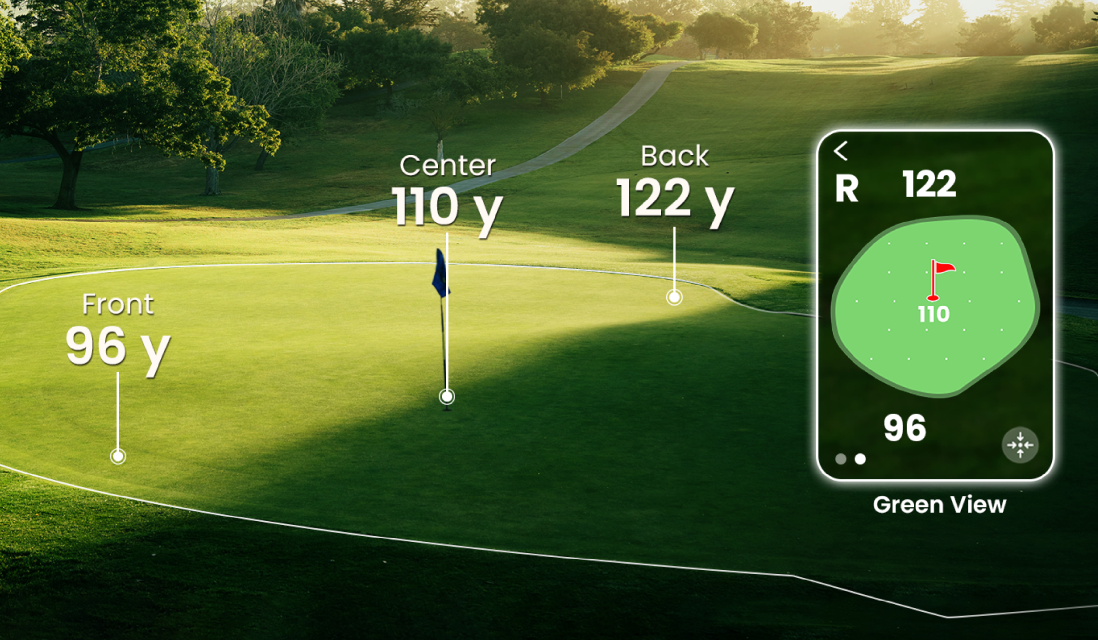
GPS may be more useful because front, center, back, and mapped hazard distances can be available even when you cannot see the target.
If you need both
A hybrid can combine exact laser distance with hole context, but the extra information only helps if you will learn the interface and use it selectively.
Two Golfers, Two Correct Answers
Editorial simulation A: the new golfer without a carry chart
Sam knows the flag is 145 yards away but does not know whether a normal 7-iron carries 125 or 145. The new number does not solve the real problem. Sam should first record carry distances at the range or in lessons.
Editorial simulation B: the 14-handicap traveler
Jordan knows a stock 8-iron carries 142 yards and plays unfamiliar courses twice a month. A 138-yard front edge and 154-yard flag can change both club and target. For Jordan, fast distance confirmation has clear decision value.
When a Simple Model Is the Better Choice
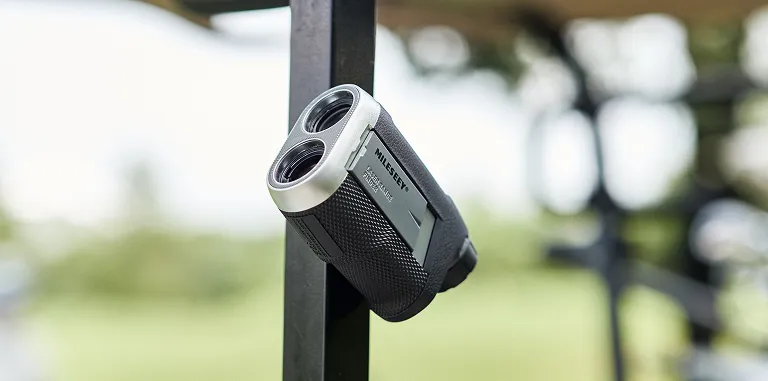
If your main need is quick flag and hazard distance, a focused laser may be more useful than a feature-heavy hybrid. A golf distance measurer such as the PF260 Tour represents that simpler category. National Club Golfer’s independent review awarded it five stars and emphasized its ease of use, compact build, and value. Read the media review.
When This Advice Does Not Apply
A rangefinder may be unnecessary when trusted course markers, a caddie, or an existing GPS already answers your distance questions. It may also be inappropriate when an event prohibits distance-measuring devices by Local Rule. Even when a device is permitted, slope and wind functions cannot be used when the Rules prohibit that information. Review the USGA guidance.
Try a Two-Week Validation Before You Buy
- For three rounds, mark every shot where a missing distance caused a club or target guess.
- Note whether a course marker or phone GPS answered the question quickly.
- Record whether exact target distance, mapped context, or both would have helped.
- Choose the simplest device category that solves the repeated problem.
Read the pillar, what a golf rangefinder does, then compare this decision with how laser measurement works and how a device fits into your carry routine.
If your two-week log shows a recurring need, explore rangefinders for golf by use case rather than feature count.