
Average driver distance is useful only when you know what was measured. A launch monitor’s carry number, a tracking app’s finish position, and the result from a golf distance finder can all be accurate while describing different parts of the shot.
For most recreational golfers, the productive question is not “How do I compare with a tour player?” It is:
How far does my normal drive carry, where does it usually finish, and how often is it still playable?
Those three numbers create better tee-shot decisions than one flattering personal best.
What Is the Average Driver Distance?
The best broad benchmark comes with important limits. The USGA/R&A’s 2024 Distance Report includes an amateur dataset whose final measured year was 2019. In that sample, male club golfers averaged 215.6 yards overall, with an average handicap of 10.8.
| Handicap group in the report | Mean driving distance |
|---|---|
| Below 6 | 239.2 yards |
| 6–12 | 219.8 yards |
| 13–20 | 200.0 yards |
| 21+ | 176.6 yards |
| Overall | 215.6 yards |
This is a real measured sample, not a universal forecast. It came from selected UK venues and cannot tell you what your driver should do. It does show why a single internet average is misleading: skill level moved the group means by more than 60 yards.
More recent on-course data points in the same direction. Arccos said its 2026 Driving Distance Report drew on almost 10 million driver tee shots from 2025. It found a 63-yard difference between scratch-to-4.9 handicap men and golfers at 30-plus, and reported that skill was a stronger predictor of distance than age. The same report also found that the highest-handicap group entered a recovery or penalty situation on 45.1% of driver shots, compared with 12% for low-handicap players.
The editorial takeaway is clear: distance without playable outcomes is an incomplete benchmark.
Carry Distance and Total Distance Are Not Interchangeable
Trackman defines carry as the distance the ball flies before it lands. Total distance adds bounce and roll.
When carry is the decision number
Use carry when the ball must clear:
- a front bunker;
- water;
- rough before a fairway shelf;
- a dogleg corner;
- an uphill rise that kills roll.
When total distance is the decision number
Use total when the landing area is open and the final position matters more than the first bounce. Firm, downwind fairways may produce substantial rollout. Wet or uphill fairways may produce almost none.
If your driver carries 205 and normally finishes at 222, calling yourself a “222-yard driver” is reasonable for an open fairway. It is reckless when a bunker begins at 210.
For a complete bag-wide version of this distinction, use the golf club distance chart and testing method.
Build a Playable Driver Profile
Record three numbers instead of one.
1. Stock carry
Hit 10 normal drivers after warming up. Remove only obvious accidents, then take the median carry. Do not select the longest five.
2. Normal total distance
Record the median finish distance in neutral conditions. Label the surface and wind. A hard summer fairway should not become your wet-spring expectation.
3. Playable miss rate
Choose a fairway-width target. Count how many shots would remain playable—not merely how many were technically in a painted fairway. A ball in light rough with a clear second shot may be a useful outcome; a 15-yard-longer ball behind a tree may not be.
The companion golf club distance calculator turns a small sample into stock carry, safe carry, and a normal window.
A Two-Club Tee Decision Matrix
Driver is not automatically correct because the hole has a tee box.
| Hole condition | Prefer driver when… | Prefer the shorter club when… |
|---|---|---|
| Wide landing area | Extra distance shortens the approach materially | Driver brings a distant penalty area into play |
| Narrow corridor | Your playable miss still clears the pinch point | Your typical dispersion reaches trees or out-of-bounds |
| Forced carry | Safe carry clears it with margin | Only your best drive clears it |
| Dogleg | Normal shape fits the corner | Driver runs through the bend |
| Firm downhill fairway | Roll has a safe stopping zone | Roll reaches a cross bunker or rough shelf |
| Into wind | Strike remains stable | Added effort widens dispersion more than distance helps |
Distance is valuable, but the decision should compare expected next shot, not just tee-shot length.
Illustrative Hole: 232 Yards to the Pinch Point
This is a modeled example, not a report of a real player test.
A golfer has:
- driver stock carry: 208 yards;
- driver normal total: 224 yards;
- driver playable miss rate: 6 of 10;
- 3-wood stock carry: 190 yards;
- 3-wood normal total: 204 yards;
- 3-wood playable miss rate: 8 of 10.
The fairway narrows sharply at 215 and a right bunker starts at 232. Driver can finish short of the bunker on an average shot, but its long outcomes and right misses occupy the danger zone. The 3-wood leaves a longer approach, yet keeps the next shot predictable.
If the hole is 430 yards and the green is open, driver may justify the risk. If it is 370 yards with a severe pinch point, 3-wood may create the lower expected score. The same distances produce different answers because the hole changes the cost of the miss.
How to Measure Driver Distance Without Fooling Yourself
Use one ball model
Mixing range balls, premium balls, and worn balls adds noise. For a baseline, use the ball you normally play.
Separate warm-up from data
Do not count the first swings or continue until fatigue changes your motion. Ten representative shots are more useful than 40 increasingly forced ones.
Mark conditions
At minimum, note wind, temperature, elevation, and turf firmness. Arccos’s 2026 report found that 10-handicap golfers in its sample gained an average 19.2 yards at elevations above 5,000 feet compared with sea level. That is too large to ignore when moving a chart between courses.
Measure the landing requirement
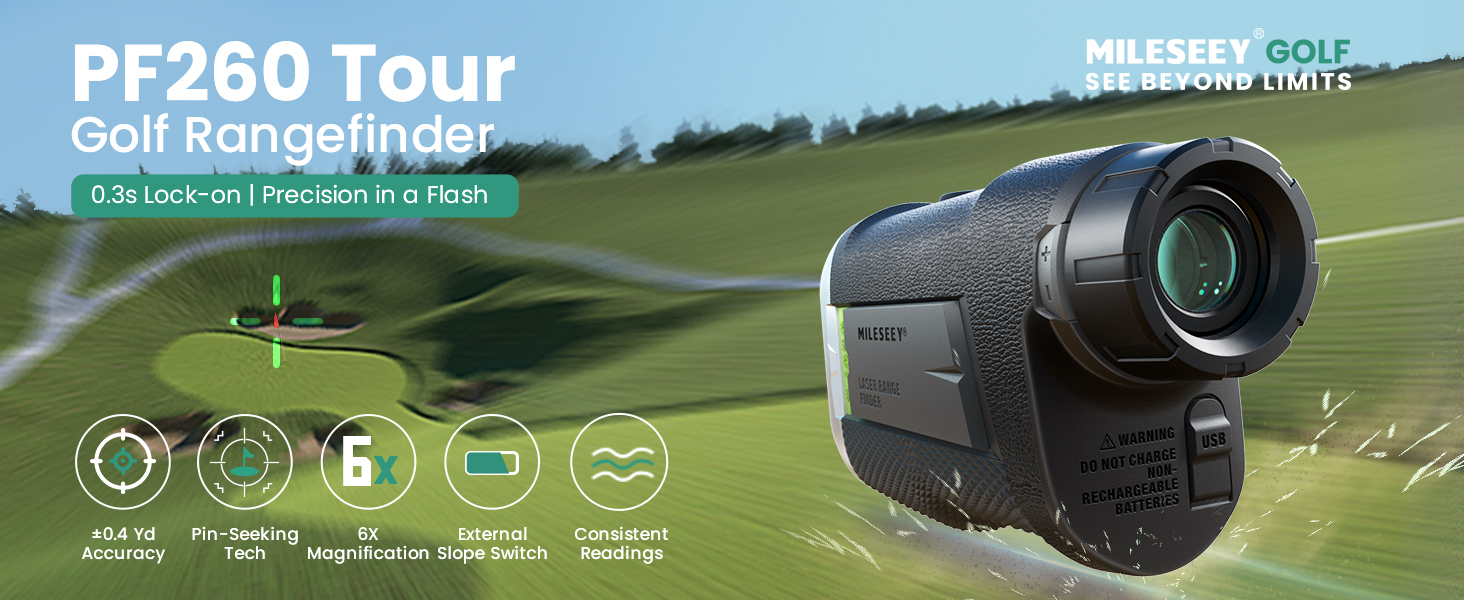
On the course, first identify the forced carry and the run-out. A simple laser can establish the geometry. The MILESEEY PF260 Tour is positioned as a straightforward option; National Club Golfer awarded it five stars and praised its ease of use, compact size, flag lock, and value (read the independent review). It still supplies only the target distance—you must bring the carry profile.
What Usually Goes Wrong
Comparing a personal best with an average
An average includes ordinary strikes. A personal best is an extreme. Compare median with median.
Chasing speed during the test
A “distance session” can become a swing-speed contest. Use normal tempo. If speed training is the goal, run it separately.
Ignoring dispersion
Ten extra yards do not automatically improve a hole if the wider pattern creates punch-outs and penalties.
Treating age as destiny
Age correlates with speed in populations, but it does not predict an individual better than current strike, speed, equipment fit, and skill. The 2026 Arccos report explicitly found skill to be the stronger predictor in its data.
Changing the pre-shot routine on the course
Measure, choose, commit. Rechecking the same number rarely improves the swing. This existing pre-shot routine guide shows how to keep distance information from slowing play.
When This Advice Does Not Apply
Do not use a distance benchmark to self-diagnose pain, a sudden speed loss, or a major equipment problem. A qualified coach, fitter, or medical professional is more appropriate.
Also, do not optimize driver distance in isolation if your course demands placement. Some golfers score better with a shorter playable pattern, and some need more distance because their current tees create repeated forced carries. Tee selection and course setup can matter as much as a few extra yards.
The Better Benchmark
Write this on your card:
- stock carry;
- safe carry;
- normal total;
- playable miss rate;
- common miss direction.
Then compare those numbers over multiple rounds. If stock carry rises while playable miss rate collapses, you have gained speed—not necessarily a better tee shot. The useful average driver distance is the one that helps you predict where the next shot will be played.
Next, compare the same perception-versus-reality gap with your average 7-iron distance, where carry control matters even more than total yardage.