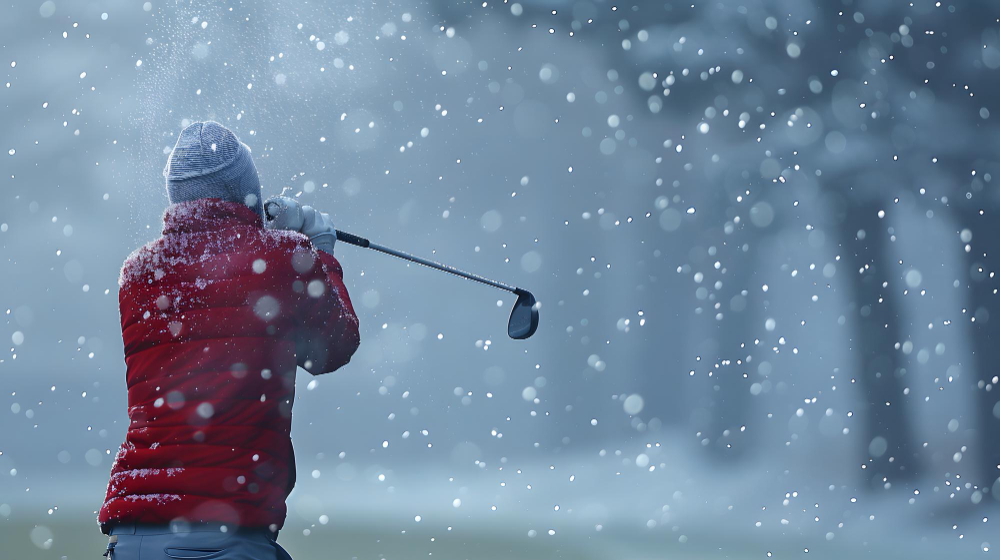
The best cold weather golf ball is usually the ball you can still launch, control, see, and trust after a fair same-day test—not automatically the lowest-compression model or the softest name on a box.
Start with room-temperature versions of your normal ball. If feel, carry, or visibility becomes a real problem, compare one candidate under the same conditions. Score both balls on carry window, dispersion, short-game control, putting feel, and visibility. A switch is worthwhile only when the candidate improves the round without creating a larger trade-off elsewhere.
What Cold Weather Changes
Colder air changes flight
Cold air is denser than warm air, which changes aerodynamic forces and generally reduces distance. The effect is mixed with wind, elevation, strike, clothing, and the temperature of the ball itself, so a single universal distance-loss formula should be treated as a starting estimate, not a club-selection rule.
Titleist's current temperature guidance says colder air and a cold ball can both reduce performance. The manufacturer recommends storing balls indoors, allowing exposed balls to return gradually to room temperature, and prioritizing consistency with a familiar model over automatically changing compression. That is manufacturer guidance, not an independent head-to-head result, but it supports a sensible first step: control ball temperature before buying a new model.
Your swing changes too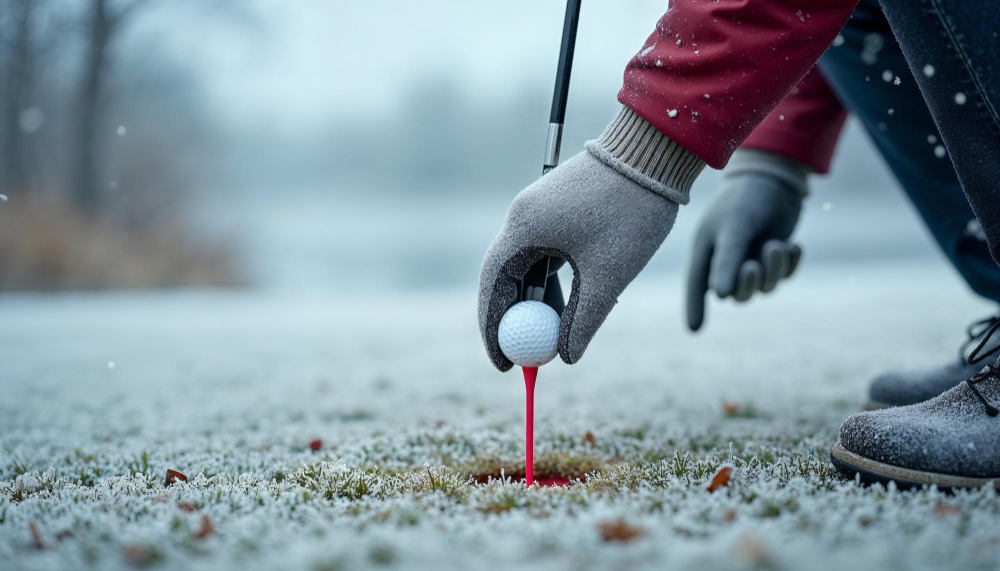
Extra layers, a shorter warm-up, cold hands, and cautious footing can reduce speed or centered contact. If every club is suddenly shorter, the ball may be only one part of the result. Use the movement test in the cold weather golf attire guide before assigning all lost carry to equipment.
The ground changes the number you observe
Soft turf can remove rollout; frozen ground can add unpredictable bounce. A ball that appears longer because it ran 25 yards on firm winter fairway did not necessarily produce more carry. Record landing distance separately from final distance.
Do Not Choose on Compression Alone
Compression describes how a ball deforms under load, but a printed number does not tell you how the complete ball will perform for your swing. Cover material, construction, aerodynamics, club delivery, and strike all matter.
A softer-feeling ball may be more comfortable in cold hands. That does not guarantee longer drives, better wedge control, or tighter dispersion. Likewise, a familiar firmer ball stored indoors may remain more predictable than an unfamiliar winter option.
Our editorial rule is: change a golf ball to solve a measured problem, not a seasonal slogan.
For the broader relationship among construction, feel, distance, and control, use the existing Golf Ball Selection Guide. This article focuses only on the cold-weather decision.
Use the Five-Factor Cold-Weather Scorecard
| Factor | What to measure | Why it matters |
|---|---|---|
| Carry window | Median and normal short-long range | Hazards care about carry, not best total distance |
| Dispersion | Normal left-right pattern | A few extra yards are poor value if misses widen |
| Short-game control | Landing and rollout from one repeatable shot | The ball affects every scoring shot, not just driver |
| Feel and sound | Driver, iron, wedge, and putter impressions | Confidence matters, but should not replace outcomes |
| Visibility | Tracking in gray sky, leaves, frost, or low sun | A ball you cannot find creates a practical penalty |
Assign each ball a 1/5 score in every category, then write one sentence explaining the score. The sentence is more important than the total because it exposes trade-offs.
Run a Fair A/B Test
Step 1: control storage
Keep both ball models indoors before the test. Do not compare a candidate carried from a warm house with a normal ball left overnight in a car. Mark each model clearly.
Step 2: use one session and one target set
Test both balls during the same 30/45 minute window. Alternate models rather than hitting all shots with one first, because temperature, wind, and your body can change during the session.
Use three shot groups:
- six drives or long-club shots;
- six mid-iron shots;
- six partial wedges plus several chips and putts.
If the range uses limited-flight balls, move the test to an appropriate practice area or compare only relative feel and dispersion. Do not combine range-ball numbers with on-course premium-ball numbers.
Step 3: keep ordinary misses
Remove only clear accidents such as a top or slip. Keep normal thin, heavy, heel, or toe strikes because the winning ball must work with your real pattern, not a highlight reel.
Step 4: separate carry from total
Use a launch monitor, known landing zones, or another consistent method available at the facility. Record carry first. If you also record total, label the surface and firmness.
Step 5: repeat on the course
Take the better practice candidate into nine holes, not directly into a tournament. Use the winter golf guide to account for attire, wind, moisture, and course restrictions. A ball that wins indoors may lose its advantage when visibility and short-game lies enter the decision.
Editorial Simulation: Familiar Ball vs Softer Candidate
The numbers below are hypothetical and demonstrate the method; they are not results from a MILESEEY test.
Conditions: 44~F, light wind, balls stored indoors, ten representative 7-iron shots per model.
| Measure | Familiar ball | Softer candidate |
|---|---|---|
| Median carry | 146 yd | 147 yd |
| Normal carry window | 141/150 yd | 140/151 yd |
| Left-right spread | 14 yd | 19 yd |
| Partial-wedge rollout | Predictable | Slightly longer |
| Visibility in leaves | Average | Excellent |
| Putting feel | Familiar | Softer than preferred |
The candidate gains one yard of median carry and is easier to see, but dispersion widens and short-game behavior is less familiar. A golfer who frequently loses balls in leaves may still choose it. A golfer preparing for competition may keep the familiar ball. The correct decision depends on the problem being solved.
Choose Visibility Intentionally
Fall and winter light can make ball tracking harder. Low sun, gray sky, dormant rough, leaves, frost, and early darkness all change contrast.
Test visibility in three moments:
- tracking the ball against the sky;
- seeing the first bounce;
- locating it from 30/50 yards away.
A bright color is not universally easiest for every eye or background. Compare actual candidates on your course. In leaf-covered areas, remember that visibility does not change the Rules: unless an applicable Local Rule provides relief, a ball not found within the search time is lost.
Create a Cold-Round Ball Routine
Before the round
- Store balls at normal indoor temperature.
- Pack enough of the same model to avoid an unplanned mid-round switch.
- Mark the ball for quick identification.
- Check course conditions and whether frozen or temporary surfaces make testing meaningless.
During the round
- Keep the spare ball protected in a pocket or bag compartment.
- Rotate only in ways permitted by the Rules and format being played.
- Record carry and landing behavior, not just final position.
- Note strike and lie before blaming the ball.
After the round
Write three lines: where the ball helped, where it hurt, and whether the change affected confidence. Repeat over several rounds before buying a season's supply.
What Usually Goes Wrong
Comparing balls at different temperatures
This confuses storage with construction. Equalize the starting condition.
Testing only with driver
A winter ball must also chip, pitch, and putt. One extra yard is irrelevant if scoring shots become unpredictable.
Treating feel as distance
A softer sound may suggest speed or compression, but measure the outcome. Feel is one scorecard category, not the result.
Using frozen or saturated rollout as evidence
Surface response can overwhelm ball differences. Record carry or wait for a more stable test.
Changing ball and clothing together
If a bulky outfit changes the swing, you cannot isolate the ball. Fix mobility first.
When This Advice Does Not Apply
Do not test on a course under frost restriction or on surfaces the staff has closed. The frost delay golf guide explains why visible thaw in one area does not mean the property is ready.
This protocol also does not replace a professional ball fitting or reliable launch-monitor session. Players with very inconsistent contact may need to stabilize strike before small equipment differences become meaningful.
Cold-Weather Golf Ball Checklist
- Begin with a room-temperature version of the normal ball.
- Name the specific problem: carry, feel, control, or visibility.
- Compare only one candidate at a time.
- Alternate models in the same session.
- Measure carry and dispersion, then test wedges and putts.
- Keep ordinary misses.
- Verify the winner over nine holes.
- Buy more only after repeated evidence.
The best cold-weather golf ball is not the model with the strongest winter claim. It is the model that wins a fair test for your swing while preserving the shots that still decide the score.
Frequently Asked Questions
Do golf balls go shorter in cold weather?
They generally can because colder air is denser and a cold ball may behave differently, but the observed loss also includes strike, layers, wind, elevation, and turf. Measure your own carry in the day's conditions.
Should I use a low-compression golf ball in winter?
Not automatically. A lower-compression or softer-feeling model may suit some players, but it can also change launch, control, sound, and putting feel. Compare it with your normal ball under equal conditions.
Is it okay to leave golf balls in the car during winter?
Long exposure to extreme temperatures can make the starting condition inconsistent. Store balls indoors and let exposed balls return gradually to room temperature before evaluating them.