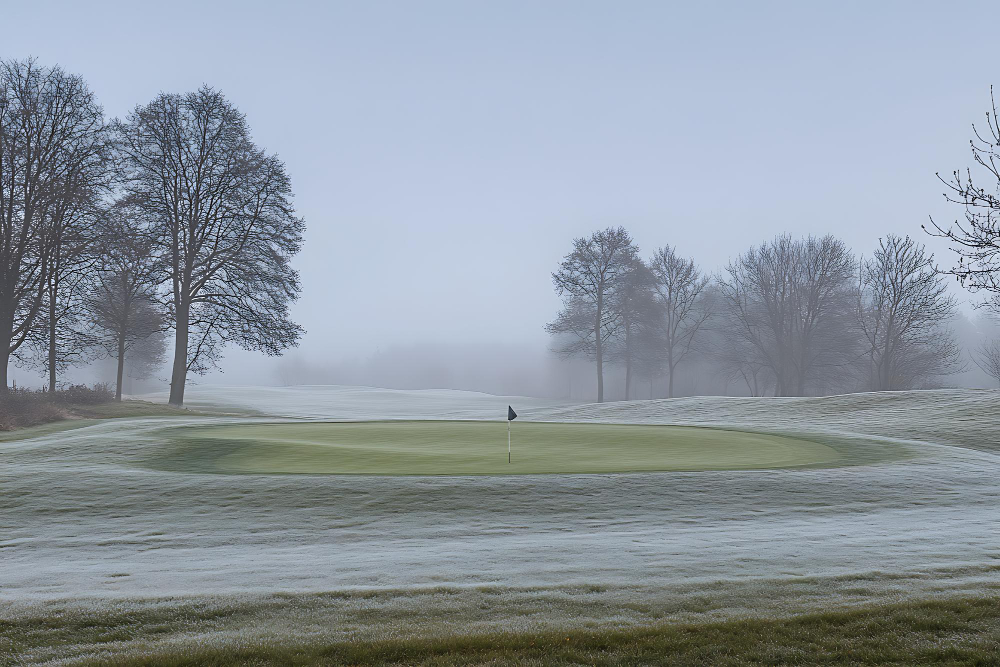
A frost delay is a temporary hold on golf-course traffic until frost has cleared from vulnerable playing areas and the maintenance team can safely prepare the course. It is not based on a single thermometer reading, and it does not end the moment your car windshield looks clear.
The useful player response is to treat reopening as a moving window, confirm the course's plan directly, and avoid walking onto closed turf. A little patience in the morning can prevent damage that remains visible for weeks.
Why Frost Stops Play
Frost makes turf vulnerable to traffic
The USGA's frost-delay explanation says ice crystals in grass plants can make them brittle. Walking or driving across frost-covered turf can rupture cells, kill or weaken the plant, and leave damage that may take more than a month to recover.
That risk is not limited to a golf cart. Foot traffic concentrates heavily on tees and putting greens. One group can leave many steps on a closely mown surface before the course has a chance to recover.
Short winter growth makes damage last
Cold-season turf may grow slowly or remain dormant. The USGA's winter-course guidance explains that divots, ball marks, cart wear, and other traffic damage can linger because the plant is not repairing at its normal rate.
The delay therefore protects more than today's appearance. It helps preserve surfaces for later winter rounds and spring recovery.
Why Your Home Can Be Frost-Free While the Course Is Closed
Golf courses contain many microclimates
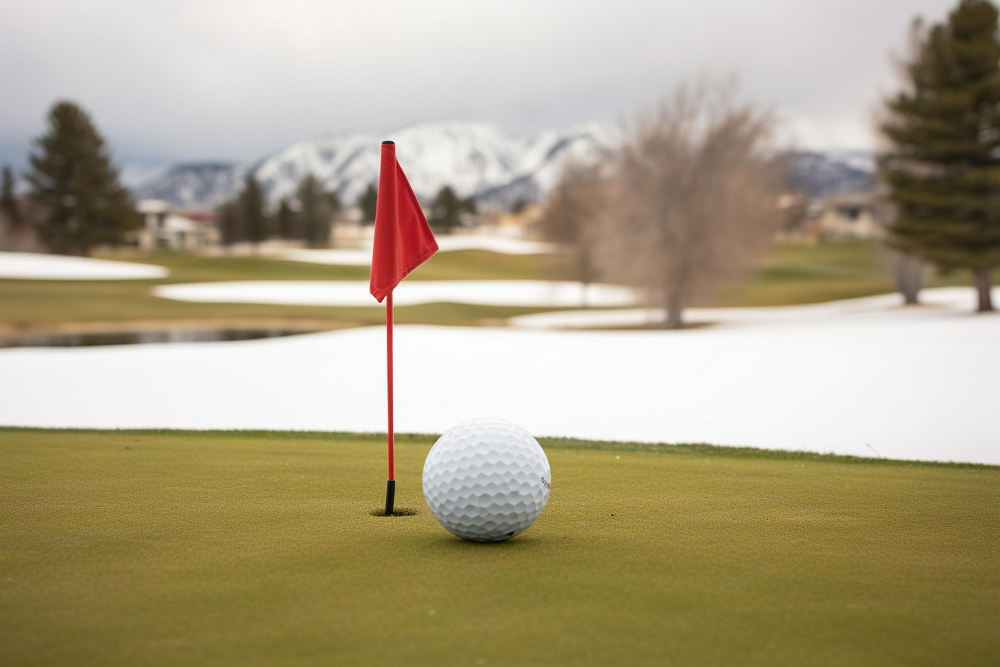
Frost can remain in low areas, shade, north-facing slopes, and sheltered sections after exposed areas thaw. A course may have a clear parking lot and first tee while an unavoidable green or fairway remains frozen.
The staff cannot safely open a route that forces every group across the vulnerable area. Conditions at one visible spot do not represent the whole property.
Surface and air temperature are not the same
The forecast air temperature is measured under standard conditions. Grass surfaces can cool differently, especially on clear nights. Dew point, wind, cloud cover, shade, soil temperature, and previous moisture all affect what forms and how quickly it clears.
That is why no responsible article can promise “frost delays end at 9 a.m.” from a forecast alone.
Thawing is not the final step
After frost clears, crews may still need time to mow, change holes, rake bunkers, move equipment, or complete other work that could not occur safely earlier. Opening time combines natural thaw and operational preparation.
How Long Does a Frost Delay Last?
There is no fixed duration. The course must evaluate all critical areas, not just the first tee. Sun angle, shade, wind, temperature trend, and course layout can shorten or extend the delay.
Use this planning model:
| Course message | How to interpret it | Your next action |
|---|---|---|
| “Frost delay; no estimate” | Staff does not yet have enough evidence | Do not leave unless the course requests it; check the next update time |
| “Estimated 60-minute delay” | A working estimate, not a guarantee | Add travel and check-in buffer; keep plans flexible |
| “First tee opens at 10:00” | Opening sequence is defined | Ask how original tee times will be handled |
| “Temporary greens / shortened course” | Play is possible under modified conditions | Decide whether the altered format still meets your purpose |
| “Course closed” | Conditions or damage risk remain unacceptable | Reschedule; do not seek an unofficial route onto the property |
What Happens to Your Tee Time?
Courses handle the queue differently. Some push every time back. Some use a shotgun restart, shorten intervals, preserve member or event blocks, or cancel early groups. Do not assume your 8:00 a.m. time becomes 9:00 a.m. because the delay lasted an hour.
Ask three precise questions
- Is my tee time delayed, canceled, or awaiting a decision?
- What is the next official update time?
- If play resumes, will the course use normal greens, temporary greens, or a shortened routing?
These questions help staff give useful answers. Repeatedly asking “Are we going yet?” cannot change the shaded green that is still frozen.
Use a Delay-Window Plan
The full winter golf guide treats course access as one part of a five-factor condition stack. For a frost morning, create three plans before leaving home.
Plan A: normal start
Pack and arrive on the original schedule if the course confirms that play is on time. Still expect colder first-hole conditions and a longer warm-up.
Plan B: delayed start
Keep breakfast, work, transportation, and family obligations flexible for a defined window. Bring removable layers because the temperature at the actual tee time may be very different from the original one. The cold weather golf attire guide includes a mobility test for adjusting those layers.
Plan C: modified or canceled round
Choose a backup practice session, later nine-hole slot, or reschedule. A useful backup prevents frustration from turning into pressure on staff or an unsafe attempt to play.
Editorial Simulation: An 8:10 Tee Time After a Clear Night
This is a planning simulation, not a report from a specific course.
Forecast: 34°F at sunrise, clear sky, light wind, warming quickly after 9:00. The player has an 8:10 tee time and a noon obligation.
Option A: assume a one-hour delay
The player leaves on the normal schedule and tells family the round will end only one hour late. The first tee thaws, but two shaded greens do not. Maintenance then needs preparation time. The uncertain start threatens the noon commitment.
Option B: use a decision deadline
The player calls at the course's stated update time and sets a personal latest-start threshold. If the course cannot confirm a start that fits nine holes plus travel, the player reschedules before driving over.
Option B does not predict the frost better. It manages the uncertainty better.
What to Do While You Wait
Stay off closed turf
Do not walk to the putting green, practice tee, or first hole until staff opens those areas. A practice surface can be as vulnerable as the course.
Warm up without exhausting the body
Use gentle mobility, indoor putting if permitted, or a short routine the staff approves. Do not complete a full warm-up and then stand still for an unknown hour; save the final swings for the confirmed start window.
Recheck the rest of the condition stack
Frost may clear into wet or thawing soil, a cart restriction, changing wind, or reduced daylight. If saturation replaces frost, the decision moves to the golf-in-the-rain and wet-course guide.
Respect Winter Course Restrictions After Opening
Opening does not mean every surface is normal. Follow temporary greens, trolley or cart limits, mats, entry/exit points, and roped areas. Replace or fill divots as instructed and repair ball marks carefully.
One warm day does not create summer recovery. The USGA notes that thawing and refreezing can leave turf especially vulnerable. Course-specific instructions outrank assumptions based on appearance.
What Usually Goes Wrong
Looking only at the first tee
An unavoidable shaded area elsewhere can hold the entire course. The staff must evaluate the complete route.
Treating an estimate as a promise
Weather and microclimates change. Keep a decision window and backup plan.
Walking onto a closed practice green
The delay applies to vulnerable turf, not just the first-hole starting order.
Comparing one course with another
Grass type, shade, elevation, drainage, staffing, and routing differ. A course across town can open earlier without proving your course is overly cautious.
Pressuring staff for a shortcut
Maintenance and golf-shop teams cannot negotiate with frozen plant tissue. Precise logistics questions are useful; pressure is not.
When This Advice Does Not Apply
Frost is only one reason for a delay. Frozen soil, snow, ice, flooding, maintenance, darkness, or lightning require different decisions. Follow the stated reason and course policy.
This guide also cannot estimate a specific reopening time. Only staff inspecting the property can make that call.
Frost-Delay Checklist
The night before
- Check the course's preferred update channel.
- Create normal, delayed, and canceled plans.
- Set a personal latest-start time.
- Pack removable layers and protect the schedule after golf.
The morning of play
- Wait for the official update.
- Ask how tee times will be sequenced.
- Confirm temporary greens, cart rules, and hole count.
- Stay off all closed turf.
After opening
- Reassess wetness, footing, daylight, and temperature.
- Follow ropes and traffic rules.
- Accept that winter surfaces may not respond like summer turf.
A frost delay is not wasted golf time. It is course care happening before your eyes. Plan for uncertainty, let the staff make the turf decision, and the course has a better chance of remaining playable through the season.
Frequently Asked Questions
What temperature causes a golf frost delay?
There is no single air-temperature cutoff. Surface temperature, dew point, wind, cloud cover, shade, moisture, and microclimate all affect frost formation and clearing.
Can golfers walk on a frosty course if they avoid the greens?
Not unless the course opens that route. Frost damage can occur beyond greens, and reaching one area may require crossing another vulnerable surface.
Does a frost delay move every tee time back equally?
Not always. Courses use different restart and cancellation policies. Ask how your specific time will be handled.