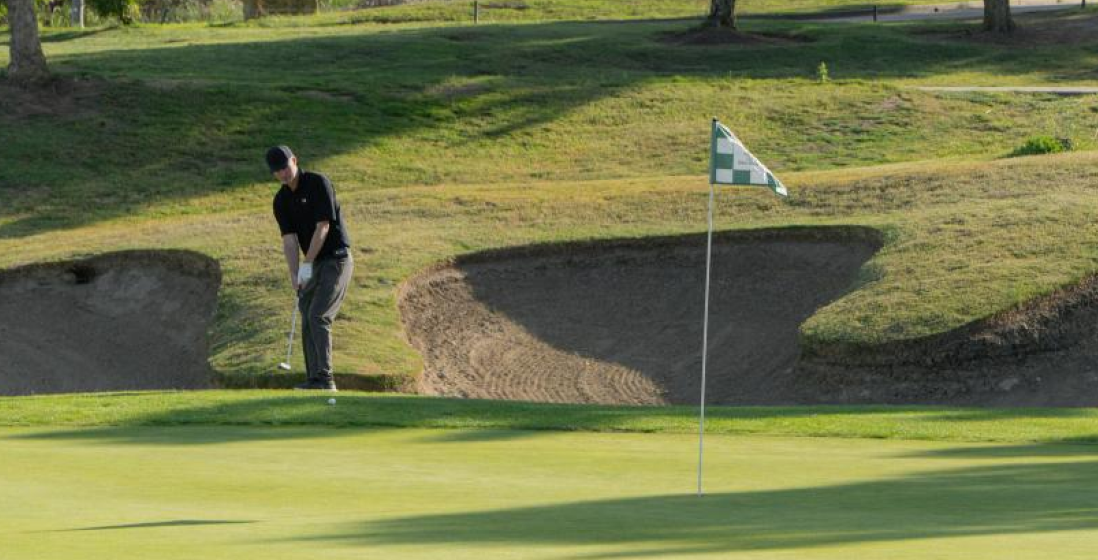
For planning, reserve about four to four-and-a-half hours for an 18-hole round in a recreational foursome. A pair on an open course may finish closer to three hours, while a busy weekend foursome, a difficult layout, or a tournament can move beyond five.
The USGA has cited an average full-round time of 4 hours 17 minutes, compared with 3 hours 45 minutes for the first group of the day. That difference is a useful reminder: your group controls its habits, but traffic and tee spacing can control the finish. Read the USGA's pace-of-play bottleneck analysis.
18-Hole Time by Group Size

The ranges below are planning estimates for a standard-length course. Always use the course's published pace when one is available.
|
Group |
Open-course estimate |
Busy-course estimate |
|---|---|---|
|
Solo |
2:15–3:00 |
Limited by groups ahead; rarely able to sustain solo pace |
|
Twosome |
3:00–3:45 |
3:45–4:30 |
|
Threesome |
3:30–4:00 |
4:00–4:30 |
|
Foursome |
3:45–4:15 |
4:15–5:00+ |
Why group size is not the whole answer
A disciplined foursome can be faster than a disorganized twosome. Four players who prepare in parallel, watch every shot, and move directly to the next position may lose less time than two players who start every decision only after reaching the ball.
Use a Per-Hole Budget
A four-hour round is 240 minutes. Divided by 18, that is 13 minutes 20 seconds per hole. A four-hour-15-minute round allows just over 14 minutes per hole.
Do not force every hole into the same allowance. Use three-hole checkpoints:
- Four-hour pace: 40 minutes per three-hole block
- Four-hour-15 pace: about 42 to 43 minutes per three-hole block
- Four-and-a-half-hour pace: 45 minutes per three-hole block
If your group is on the course's stated pace and directly behind the group ahead, it is in position. If an empty hole opens, the checkpoint shows the size of the gap without encouraging anyone to rush a swing.
The Delay Ledger: Where a Full Round Gains or Loses Time
Tee intervals and traffic
Closely spaced tee times can create a queue at the first par 3 or reachable par 5. Once groups stack up, a cart cannot drive through the bottleneck.
Searches and provisional balls
The Rules allow a three-minute search once the player or caddie begins looking. If a tee shot may be lost outside a penalty area or out of bounds, a correctly declared provisional can prevent a long return to the tee.
Cart rules and routing
Cart-path-only conditions can make riding slower on individual holes because players repeatedly cross the fairway. Take several likely clubs and a towel before leaving the cart.
Decision time
Distance, lie, wind, target, and club selection should not begin from zero at the ball. Watch the shot, move to your ball, and narrow the decision while others play.
Green exits and scoring
Replace the flagstick if needed, collect equipment, and move to the next tee. Record scores there while the first player prepares to hit.
Can a Distance Tool Make the Round Faster?
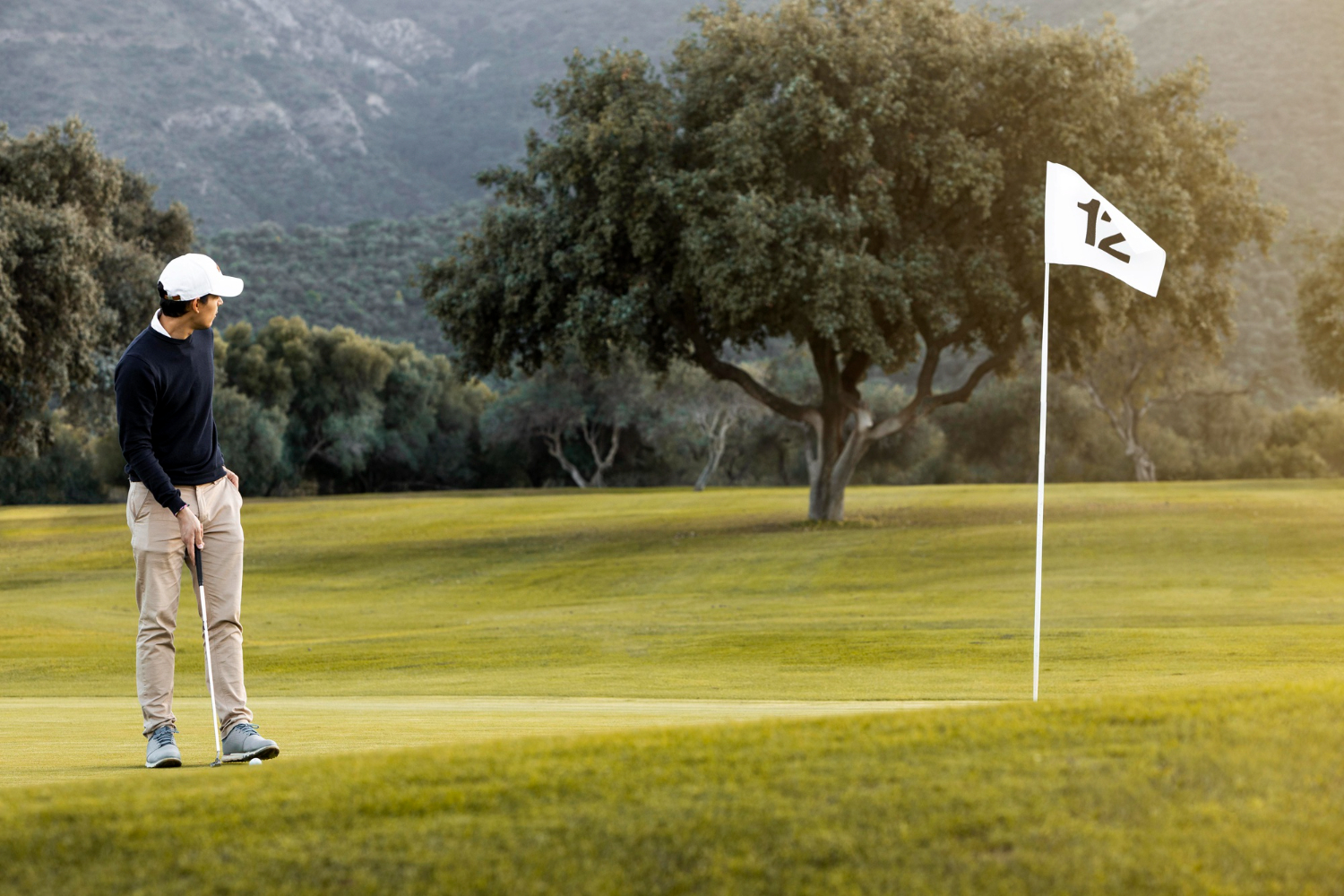
Sometimes. A golf rangefinder for quick target checks can shorten repeated pacing, sprinkler-head searches, or debates about a carry. It only saves time when the user has a short routine: retrieve, measure, choose, return.
The USGA also lists an electronic rangefinder or golf GPS as a possible pace aid when permitted. The important phrase is when permitted; competitions and courses may apply a Local Rule. See the USGA pace suggestions for players.
Editorial Simulation: Two Foursomes, Same Tee Time Pattern
This is an editorial simulation, not a field test.
Group A and Group B each average 95 strokes per player. Both have a four-hour-15 target.
Group A: serial preparation
Players stay together at every ball. Yardage is checked only when the player is away. Two people return to the cart for clubs. Scores are discussed beside the green. The group loses roughly one to two minutes on many holes without any single dramatic delay.
Group B: parallel preparation
Players separate safely toward their balls, carry extra clubs in cart-path-only conditions, watch each shot, use a provisional when appropriate, and score on the next tee. Their swing routines are unchanged.
Expected outcome: Group B is more likely to stay inside the checkpoint budget. The difference is workflow, not handicap.
When Four Hours Is Not a Fair Expectation
- A course publishes a longer target because of routing, elevation, or long green-to-tee transfers.
- Weather, maintenance, a ruling, an injury, or a suspension interrupts normal play.
- A tournament format adds scoring, officiating, or event stations.
- Cart-path-only rules create long cross-fairway walks.
- The entire course is backed up and your group remains directly behind the group ahead.
A Simple Full-Round Plan
- Check the course's pace and cart policy before leaving home.
- Arrive early enough to organize equipment before the tee time.
- Agree to safe ready golf in stroke play.
- Use three-hole checkpoints and position behind the group ahead.
- If a gap opens, recover time during transitions for the next three holes.
- Do not hit into the group ahead or compromise safety to meet a clock.
For the wider framework, read the golf pace-of-play guide. Turn the course target into checkpoints with the pace-of-play calculator. To remove avoidable delays, use the ready-golf checklist.