Choose a golf GPS speaker if you ride, want audio, and prefer one visible control center on the cart. Choose a handheld GPS if you walk, value low weight, or want yardage in your hand without paying for a speaker. If your rounds alternate between cart and foot, a detachable GPS speaker can bridge the two formats.
The choice is less about which device has more features and more about where the information is when you need it.
Quick comparison
|
Decision factor |
GPS speaker |
Handheld GPS |
|---|---|---|
|
Best for |
Riding, group audio, integrated setup |
Walking, portability, golf-first use |
|
Yardage access |
Voice and/or cart-mounted screen |
Screen or voice in hand |
|
Weight |
Usually heavier |
Usually lighter |
|
Mounting |
Often magnetic |
Pocket, clip, or bag |
|
Audio |
Core feature |
Usually absent or secondary |
|
Battery system |
May involve speaker and GPS batteries |
Usually one battery |
The Ride-Walk-Detach scorecard
Score one point for each statement that sounds like your normal round.
GPS speaker points
- I ride most rounds.
- I already bring a speaker.
- I want audible yardages without opening a phone.
- I have a reliable steel mounting surface.
- My group normally agrees on music.
Handheld GPS points
- I walk most rounds.
- I want the lightest practical setup.
- I often leave the cart to find or play a ball.
- I do not need shared audio.
- I prefer one battery and one purpose.
A clear lead points to the format. A tie suggests a detachable system or a handheld used alongside a speaker you already own.
Riding: a speaker reduces reach and screen switching
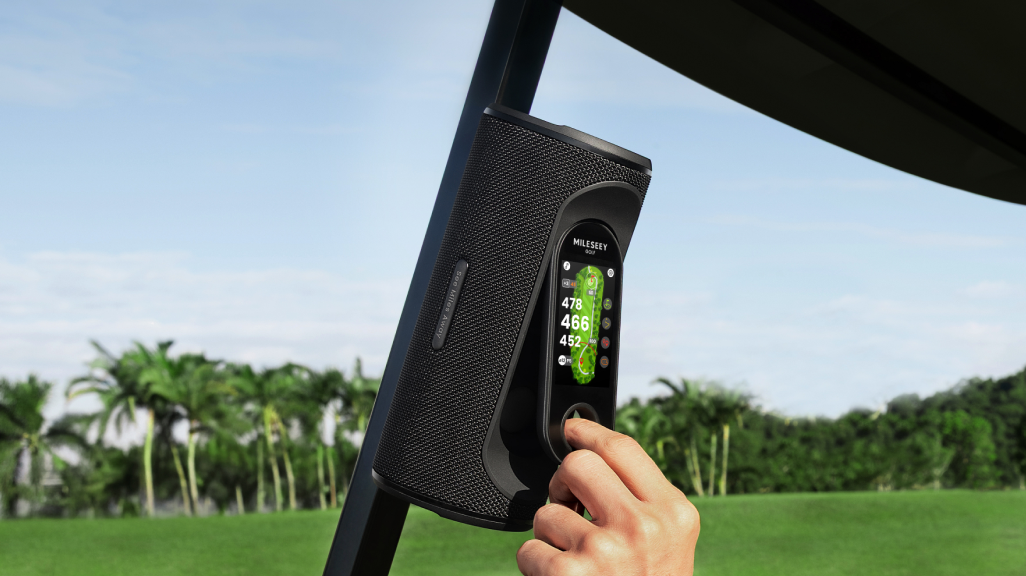
On a cart, a magnetic GPS speaker can remain visible and audible. That makes center-green checks fast and keeps music controls in one place. The risk is dependence on the cart: the speaker may be several dozen yards from the ball during cart-path-only play, and not every cart has a safe steel surface.
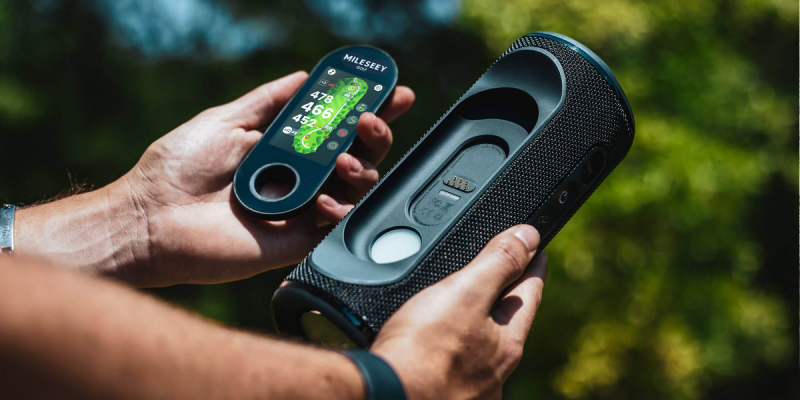
A detachable GPS display solves part of that problem. You leave the speaker mounted and carry only the screen. Within MILESEEY’s golf GPS collection, the GeneSonic Pro is one example of this architecture; its official configuration combines a magnetic speaker with a detachable 3-inch touchscreen.
Walking: weight and access dominate
-10.png?w=1098&h=576)
Every unnecessary pound matters more over 18 holes than it does in a product comparison table. A handheld GPS can live in a pocket or on a bag and keeps the golf function independent from group audio. MILESEEY’s GeneSonic Go, for example, is listed at 110 grams and uses a 3-inch color touchscreen with 43,000+ preloaded courses.
A walking golfer who still wants music can pair a compact speaker with a handheld, but the total system then includes two devices, two charge states, and two controls. That may still be right if each device is already owned and trusted.
Editorial simulation: one wet Saturday
This is a hypothetical scenario, not a field test. Heavy overnight rain creates cart-path-only rules. On the seventh hole, the ball finishes on the far side of a wide fairway.
A fixed GPS speaker provides the cart number, so the player estimates the lie and carries three clubs. A handheld GPS travels to the ball and provides mapped distances there. A detachable system behaves like the handheld for this shot, then returns to the speaker. The decision turns on mobility, not nominal GPS accuracy.
Compare total setup cost, not device price
Total cost includes accessories, subscriptions, phone dependence, replacement risk, and duplicated equipment. Ask:
- Would the GPS speaker replace a speaker and a GPS you were going to buy anyway?
- Does the handheld require a paid map or feature plan?
- Do you need a case, clip, mount, or power bank?
- Will you still carry a laser for exact flag distance?
- How many batteries must be charged before a round?
Integration saves money only when it replaces something. Otherwise, it can become the most expensive way to duplicate a feature.
When neither option is enough
GPS distances are mapped positions, not direct measurements of the physical flag. Golfers who need precise line-of-sight pin distance may still prefer a golf rangefinder. The broader guide to GPS versus laser rangefinders covers that separate decision.
Our recommendation
- Mostly ride and want music: start with a GPS speaker.
- Mostly walk and do not need music: start with a handheld GPS.
- Often face cart-path-only play: prioritize handheld or detachable GPS access.
- Already own a speaker: a handheld may avoid replacing working gear.
- Want one integrated system: compare detachable designs, battery independence, and offline behavior.
Next, use the full golf speaker buying guide to compare mounting, sound, battery, and weather protection. If connectivity is your main concern, read whether a GPS speaker needs a phone or subscription.
If your preferred format mounts on the cart, also run the magnetic speaker placement and safety check before buying.
For current MILESEEY configurations, compare the GeneSonic Pro and GeneSonic Go official US pages. Confirm course coverage, price, and availability before deciding.