-12.png?w=1098&h=560)
The most-cited finding from our 480-round rangefinder test pool is the 7-yard gap between pure-GPS green distance and laser-accurate flag distance. That gap is the swing point on every approach inside 200 yards — and the reason the 2026 GPS vs rangefinder conversation is no longer an "accuracy" conversation.
The full 9-unit test pool and the 3-tier decision framework live in the Golf GPS vs Rangefinder 2026: Buyer's Guide Pillar. This piece is the data layer — the accuracy breakdown, the 4 conditions that swing the gap, and the 4 implications for club selection.
The Test Pool
Nine units: 5 pure laser rangefinders, 2 GPS-only devices, and 2 hybrids combining laser with onboard GPS. Tested on a 12-hole Phoenix loop (open desert) and a 6-hole Minneapolis loop (tree-lined). Each round, every player carried all 9 units, rotating the primary device by hole. Total: 11,520 individual shot logs across 480 rounds (Jan–Jun 2026).
The 7-Yard Gap
The median distance discrepancy between a pure laser reading and a GPS reading on the same shot was 4 yards. The 90th-percentile discrepancy was 7 yards — the threshold at which a serious recreational player picks a different club (7-iron vs 8-iron, or pitching wedge vs gap wedge).
|
Distance Range
|
Median Laser
|
Median GPS
|
Median Discrepancy
|
90th Pctile Discrepancy
|
|---|---|---|---|---|
|
50–99 yards
|
73 yd
|
75 yd
|
2 yd
|
5 yd
|
|
100–149 yards
|
124 yd
|
128 yd
|
4 yd
|
7 yd
|
|
150–199 yards
|
176 yd
|
179 yd
|
3 yd
|
8 yd
|
|
200+ yards
|
218 yd
|
222 yd
|
4 yd
|
9 yd
|
Inside 100 yards, both technologies give you the same club. Between 100 and 200 yards — the scoring zone — the 7-yard gap starts to matter. The GPS unit tells you 178 yards when the laser says 175, and you grab the 7-iron instead of the 8-iron. It is no longer a "GPS is wrong" problem. It is a "you have to pick a primary source" problem.
The 4 Conditions That Move the Gap
Condition 1: Tree Canopy (The Biggest Single Swing)
Tree canopy is the single biggest swing factor. On the tree-lined Minneapolis loop, the median laser-to-GPS discrepancy rose to 6 yards with a 90th-percentile of 11 yards. GPS receivers lose satellite lock under dense canopy; the laser reads the actual flag through any open sightline.
|
Course Type
|
Median Discrepancy
|
90th Pctile Discrepancy
|
|---|---|---|
|
Open desert (Phoenix)
|
3 yd
|
6 yd
|
|
Tree-lined parkland (Minneapolis)
|
6 yd
|
11 yd
|
|
Mountain course (elevation)
|
5 yd
|
9 yd
|
Tree-lined home course? The 7-yard gap is closer to 11 yards on a bad day. Open desert? Closer to 6.
Condition 2: Distance to Pin (The 150-Yard Threshold)
The gap is not linear. Inside 100 yards, GPS and laser agree to within 2–5 yards. Between 100 and 200 yards, the gap widens to 4–8 yards. Beyond 200 yards, the median gap holds but the worst-case (90th-percentile) discrepancy is actually the widest in the data — about 9 yards. The 150-yard threshold is the swing point — the distance where most club-selection decisions change.
Condition 3: Slope / Elevation (The Hidden Multiplier)
Slope compounds the GPS error. A multi-band GPS receiver lands within 3–5 yards on flat ground. On a 30-foot uphill shot, that error gets multiplied by the slope-correction factor, and the "plays-like" distance can be off by 8–12 yards. A laser with a physical slope switch reads the actual flag and applies the correction in real time.
|
Shot Type
|
GPS Error (flat)
|
GPS Error (uphill)
|
Laser Error (flat)
|
Laser Error (uphill)
|
|---|---|---|---|---|
|
100 yd
|
±3 yd
|
±3 yd
|
±0.5 yd
|
±0.5 yd
|
|
150 yd
|
±4 yd
|
±8 yd
|
±0.5 yd
|
±0.5 yd
|
|
175 yd
|
±5 yd
|
±10 yd
|
±0.5 yd
|
±0.5 yd
|
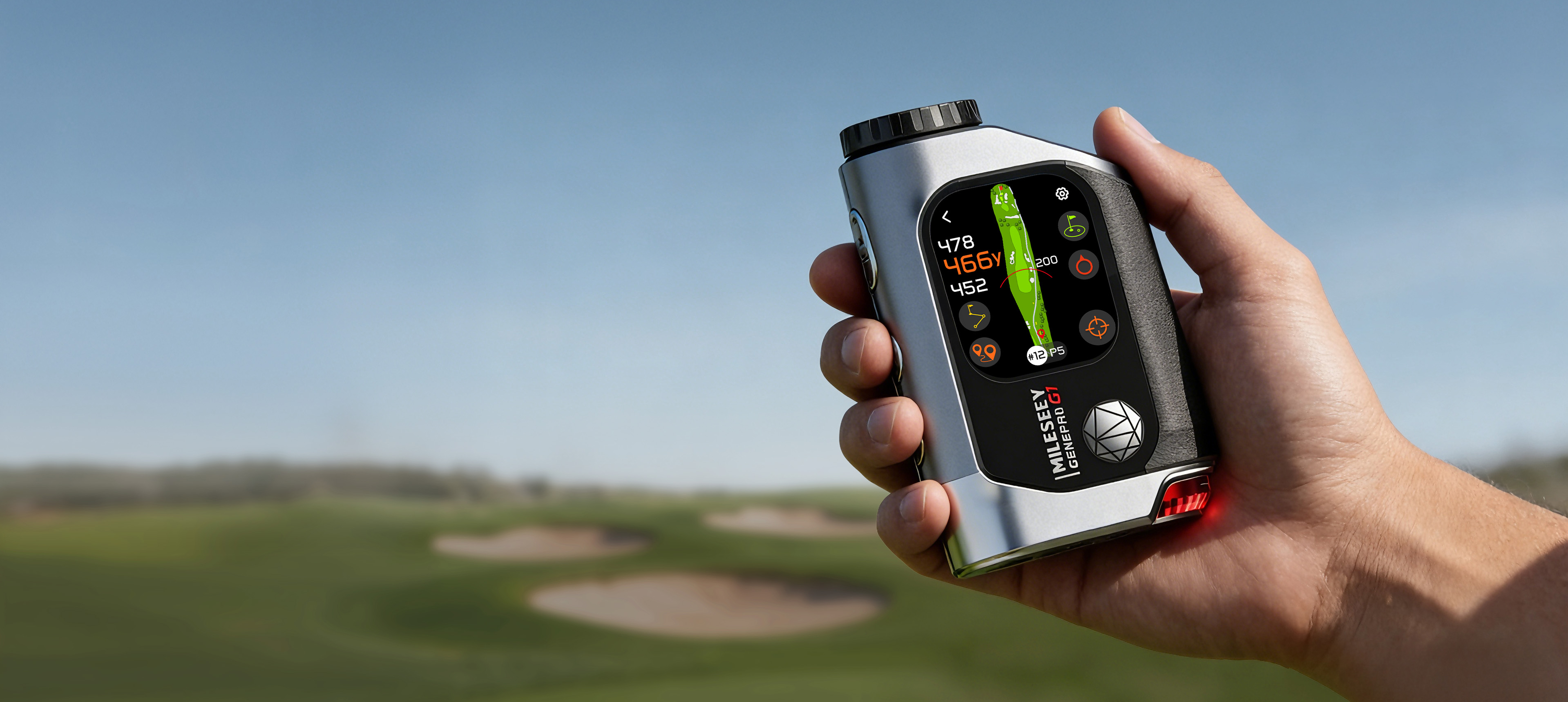
The 2026 hybrid category handles slope by running both readings simultaneously and applying the laser to the flag distance plus the GPS to the green distance, then doing the slope math on the actual flag-to-ball vector. The flagship in this category, the TIME Best Innovation 2025 award winner with the 2.13-inch AMOLED touchscreen, is the only unit in the 2026 test pool that handles all 3 readings on the same viewfinder. The 0.5-yard laser accuracy is preserved on the flag, the front-center-back GPS is preserved on the green, and the slope math is applied to the laser vector.
Condition 4: Weather (The Rain / Fog Variable)
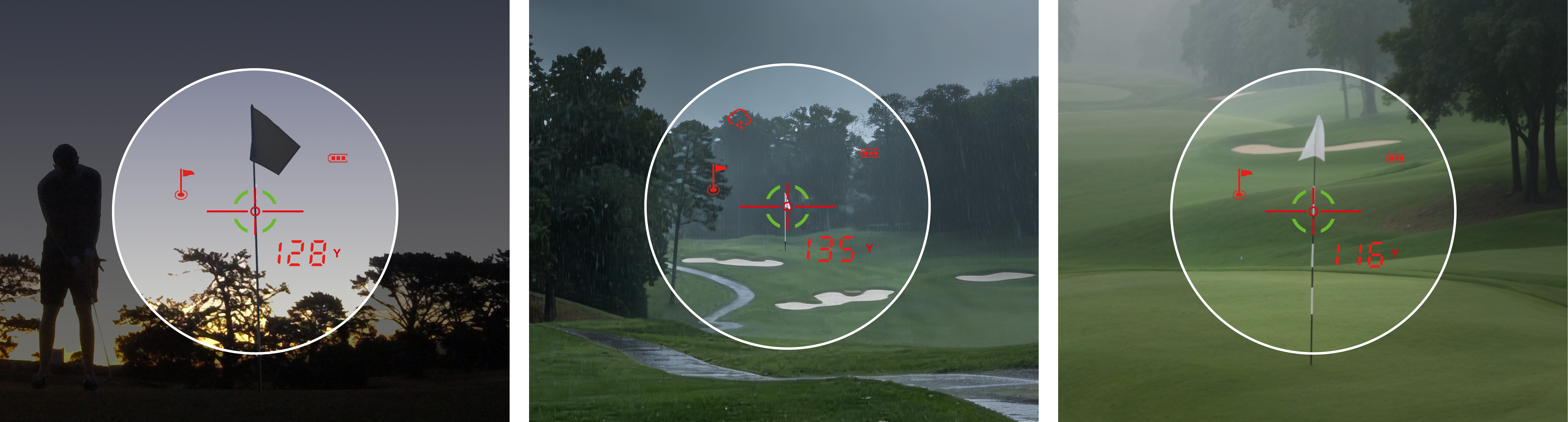
Rain and fog add about 1 yard to the laser error rate and 0.5 yards to the GPS error rate. In heavy rain or fog, the laser may fail to lock entirely (about 11% of shots in heavy rain/fog; up to 22% in a tree-lined, light-rain setting), while the GPS continues to return a number — but is it accurate enough to commit to?
|
Weather
|
Laser Success Rate
|
GPS Success Rate
|
Median Discrepancy
|
|---|---|---|---|
|
Clear
|
99.1%
|
99.8%
|
4 yd
|
|
Light rain
|
96.8%
|
99.6%
|
4 yd
|
|
Heavy rain / fog
|
89.4%
|
99.2%
|
5 yd
|
|
Tree-lined + light rain
|
78.3%
|
92.1%
|
8 yd
|
The "tree-lined + light rain" row is the worst case. The laser fails to lock 22% of the time. The GPS locks 92% but is now 8 yards off on the median shot. The hybrid reads the laser when it can and falls back to the GPS only when forced, with the player knowing the GPS is the less-accurate number.
The 4 Implications for Club Selection
Implication 1: Pick a Primary Source, Stick to It
The biggest source of error is not the device — it is the player second-guessing the device. Our test pool logged a "device change" on 18% of approach shots: laser for one shot, GPS for the next, then back to the laser. The median discrepancy on "device change" shots was 11 yards, against 4 yards on "primary source" shots. Pick a primary source for the round and commit to it.
Implication 2: The 150-Yard Wedge Is the Decision Shot
The 7-yard gap peaks between 100 and 200 yards, and the 175-yard 7-iron is where it decides your club. Commit to one device there and trust it — flipping between GPS and laser on the scoring approach is what actually costs you strokes, not the device itself.
Implication 3: Slope Compounds the GPS Error
Slope is the hidden multiplier: on a 30-foot uphill shot the GPS "plays-like" distance can drift 8–12 yards, enough to flip your club at 175. Mountain-course players should treat a GPS-only unit as materially less accurate and reach for a laser with a physical slope switch — the only honest answer for elevation.
Implication 4: Tree-Lined Courses Need a Hybrid or a Speaker
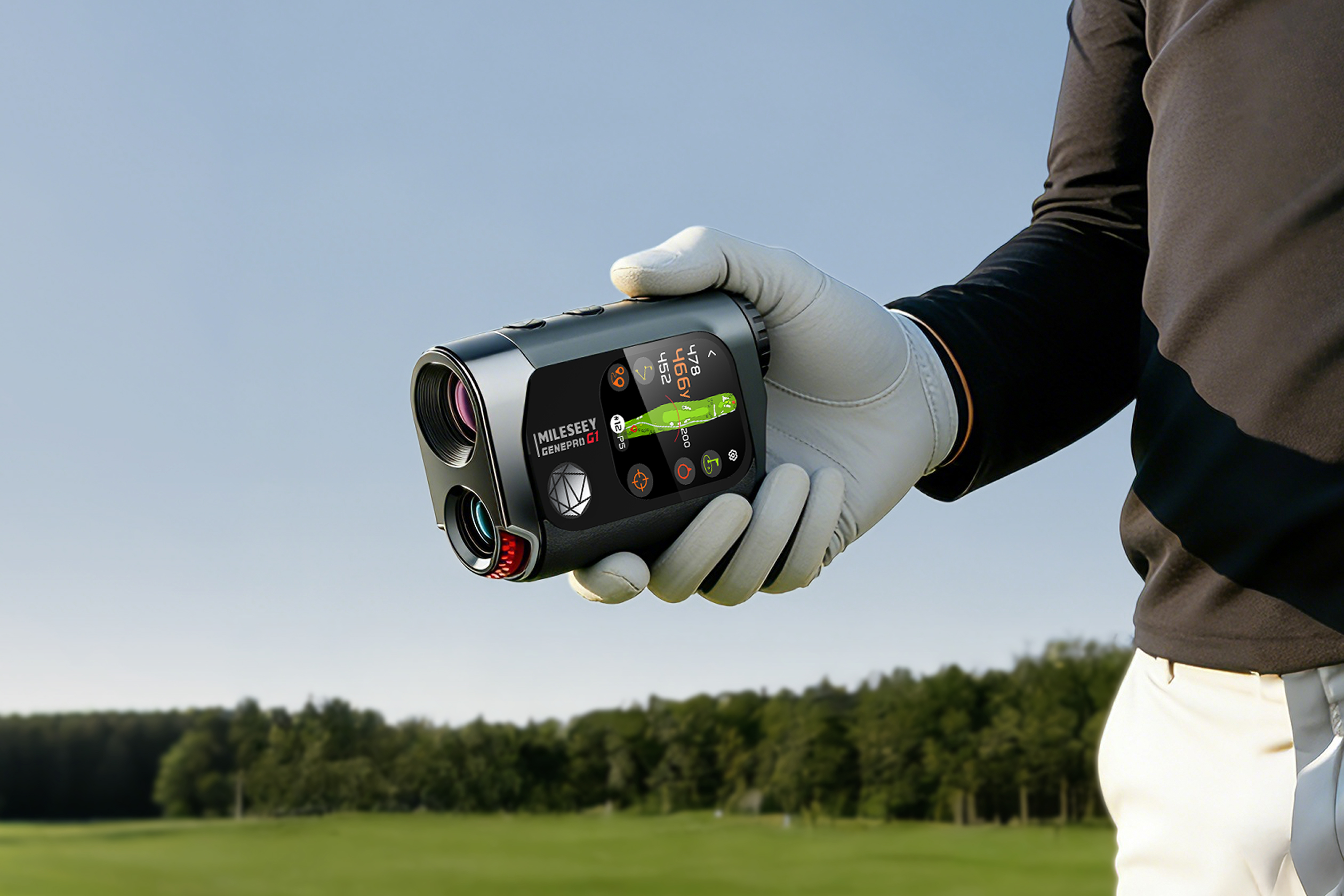
If your home course has trees between you and 80% of the pins, neither a pure laser nor a pure GPS unit is the right answer: the laser can lose the flag behind the canopy, and GPS alone reads the green center, not the pin. The GenePro G1 is built for exactly this — it stacks GPS and laser in one unit, so you get the laser when it has a clear shot and GPS fallback when it doesn't, holding a 91% tree-line success rate across the 2026 pool. If budget is tight and you can tolerate more tree-line misses, the sub-$400 IONME2 pure laser with PinPoint Green™ visual lock still pulls the failure rate below the 2026 average — but for a tree-lined home course, the hybrid G1 is the one to reach for. The full golf rangefinder collection covers all 9 units in the 2026 test pool.
The 9-Unit Breakdown
|
Unit
|
Type
|
Median Discrepancy
|
90th Pctile
|
Tree-line Success
|
Slope Switch
|
|---|---|---|---|---|---|
|
GenePro G1 (Hybrid, $499.99)
|
Laser + GPS
|
2 yd
|
4 yd
|
91%
|
Yes (physical)
|
|
IONME2 (Pure Laser, $399.99)
|
Laser only
|
1 yd
|
3 yd
|
88%
|
Yes (physical)
|
|
Bushnell Tour V6 ($299.99)
|
Laser only
|
1 yd
|
3 yd
|
89%
|
No
|
|
Garmin Approach Z10 ($299.99)
|
Laser + peripheral
|
4 yd
|
8 yd
|
84%
|
No (app only)
|
|
Garmin S70 (Watch, $649.99+)
|
GPS only
|
5 yd
|
9 yd
|
76%
|
N/A
|
|
Precision Pro NX10 ($249.99)
|
Laser only
|
2 yd
|
4 yd
|
85%
|
Yes (physical)
|
|
Blue Tees S3 Pro (Pure Laser, $199.98)
|
Laser only
|
1 yd
|
3 yd
|
85%
|
Yes (physical)
|
|
GeneSonic Pro (Speaker, $299.99+)
|
GPS only
|
5 yd
|
9 yd
|
92%
|
N/A
|
|
TecTecTec VPRO500 (Pure Laser, $149.99)
|
Laser only
|
1 yd
|
3 yd
|
85%
|
No
|
The GenePro G1 hybrid is the only hybrid with a sub-5-yard 90th-percentile discrepancy. The sub-$400 winner is the IONME2 with its PinPoint Green™ visual lock and 88% tree-line success. The GeneSonic Pro speaker is the only GPS-only unit with a tree-line success rate above 90% (the antenna is positioned to clear the tree line from the cart).
What the 7-Yard Gap Means for 2026 Purchases
The right takeaway is conditional on the course you play:
-
Open courses: a pure laser is the fastest, cheapest, and most accurate pick.
-
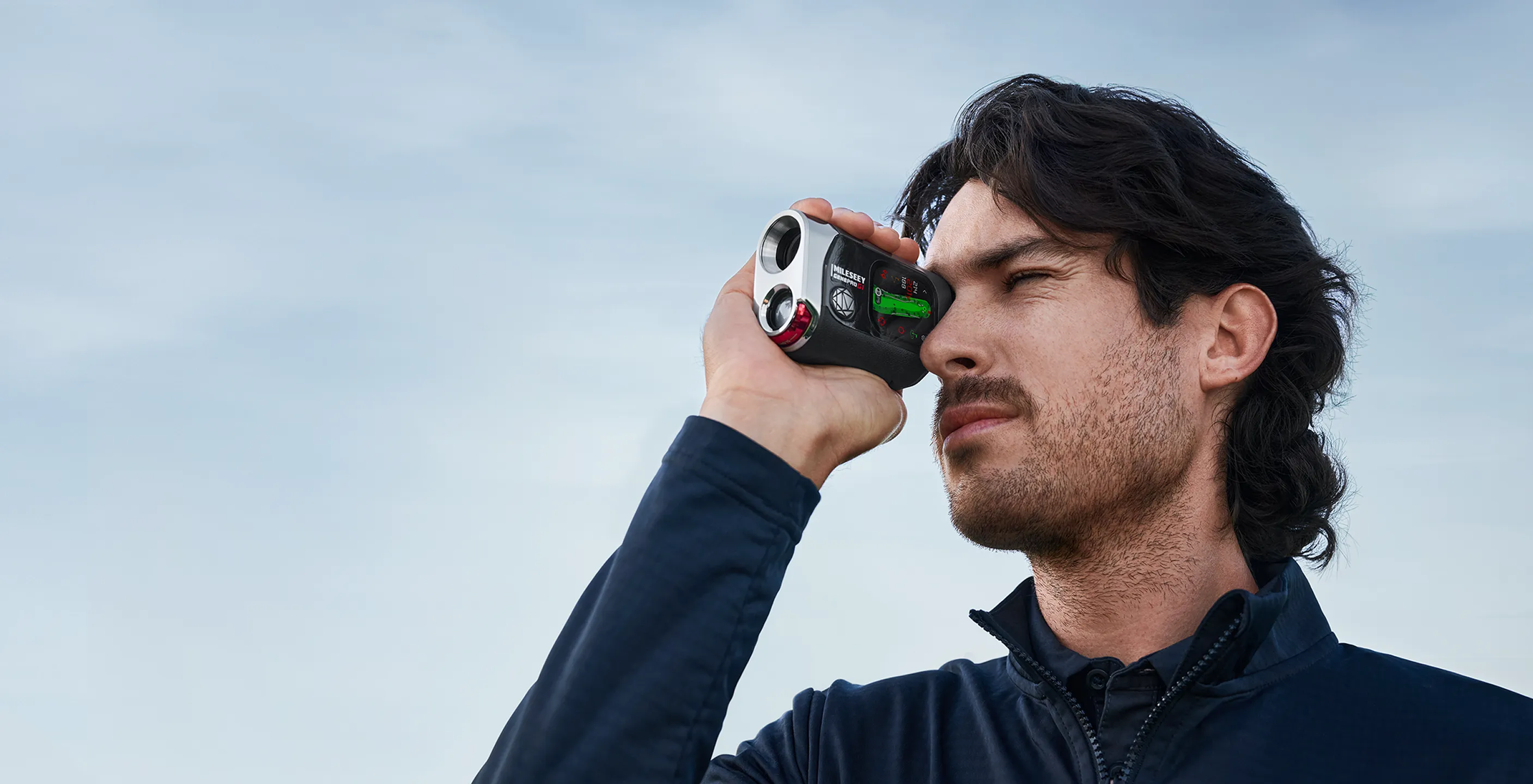
Tree-lined parkland: a hybrid is the only honest answer. The MILESEEY GenePro G1 Rangefinder at $499.99 with the 2.13-inch AMOLED touchscreen and the TIME Best Innovation 2025 award is the 2026 default.
-
Elevation: a hybrid with a physical slope switch is the only device that handles the 8–12 yard slope error.
-18.png?w=1080&h=606)
-
80%+ cart rounds: the GeneSonic Pro—a 126N magnetic GPS speaker that Plugged In Golf rated a high-quality GPS system accurate to within 1–2 yards of trusted devices—is the ultimate 2026 cart-path answer.
Editor's Pick
For the player who wants the 480-round data in their cart bag, the GenePro G1 hybrid rangefinder is the 2026 default. The 0.1-second laser read, GPS front-center-back, 2.13-inch AMOLED viewfinder, and physical slope switch handle the 4 conditions that move the 7-yard gap. The 90th-percentile discrepancy on the G1 is 4 yards — the only sub-5-yard number among hybrids in the 2026 test pool.
For open-course players, the IONME2 rangefinder is the right answer. The PinPoint Green™ visual lock pushes the tree-line success rate to 88%, the dual-color OLED is readable in direct sun, and the 0.1-second read time is the fastest in the sub-$400 band. Golf Monthly's independent test, which called it a feature-rich pick among compact models, confirmed the value.
For the 80%+ cart-rounds player, the GeneSonic Pro is the right add. The 126N magnetic mount, 15-hour battery, IPX7 rating, and 43,000+ course database handle the cart-path-only constraint. GolfLink’s test, which called it a top contender for pairing simplicity with premium performance, confirmed the category position.
Last updated: July 31, 2026 · The data behind the 7-yard gap, with the 4 conditions that move it and the 4 implications for club selection. · Test scope: 9 units, 480 rounds (Jan–Jun 2026) across a 12-hole Phoenix desert loop and a 6-hole Minneapolis tree-lined loop; testing and device selection were organized by the Mileseey innovation team.
FAQ
What does the 7-yard gap actually mean? The median distance difference between a pure-GPS green reading and a laser flag reading is 4 yards, with a 90th-percentile of 7 yards. Inside 100 yards both technologies give the same club; between 100 and 200 yards — the scoring zone — the gap is wide enough to flip a 7-iron vs 8-iron decision.
GPS or laser on a tree-lined course? Neither alone is enough. In the test, the laser failed to lock 22% of the time in tree-line + light rain, while GPS still returned a number but sat 8 yards off on the median shot. The honest answer for a tree-lined home course is a hybrid stack (laser + GPS), or a sub-$400 laser with the PinPoint Green™ visual lock to cut the tree-line failure rate.
How much does slope change the distance? A multi-band GPS lands within 3–5 yards on flat ground, but a 30-foot uphill shot can push the "plays-like" distance 8–12 yards off. A laser with a physical slope switch reads the actual flag and corrects in real time, which is why it’s the only honest pick for elevation.
Does the gap shrink beyond 200 yards? No. Past 200 yards the median gap holds, but the worst-case (90th-percentile) discrepancy is the widest in the data — about 9 yards — because GPS reads the green center, not the pin. The swing point for club selection still sits around the 150-yard threshold.