For years, golf technology focused on one simple, standalone task: measuring yardage to the flag. However, as we head into 2026, the landscape of golf equipment has undergone a fundamental shift. The future of the game is no longer centered around single-feature, isolated gadgets. Instead, the industry is moving toward a highly connected, smarter, and more intuitive on-course ecosystem. By seamlessly blending AI-powered course analysis, interactive touchscreen GPS mapping, wearable smart assistance, and real-time environmental sensors, modern gear is designed to help golfers play with fewer interruptions and maximum confidence.
Rather than cluttering the game with high-tech distractions, 2026’s golf tech is engineered to eliminate them. From advanced golf rangefinders with slope compensation to wearable GPS units and digital, AI-driven caddies, the overarching goal of modern golf technology is simple: deliver richer, more actionable data through lighter, more streamlined experiences. Today's golfers demand deep insights without the hassle of carrying multiple devices. They want to spend less time managing equipment and more time staying in their playing rhythm, enjoying the round, and naturally improving their score.
1. Why Touchscreen GPS and Rangefinders Are the New Gold Standard
Traditional laser rangefinders are exceptional at one specific task: shooting a line-of-sight distance to a visible target. However, a real round of golf is dynamic, and players rarely need just a single number. Golfers often find themselves repeatedly pulling a device out of its case to check hazards, map out landing zones, or calculate the distance to the back of the green—actions that inherently disrupt the natural flow and pace of play.
This is where the integration of touchscreen golf GPS and rangefinders with screen changes the game by consolidating all critical course information onto a single, interactive platform.
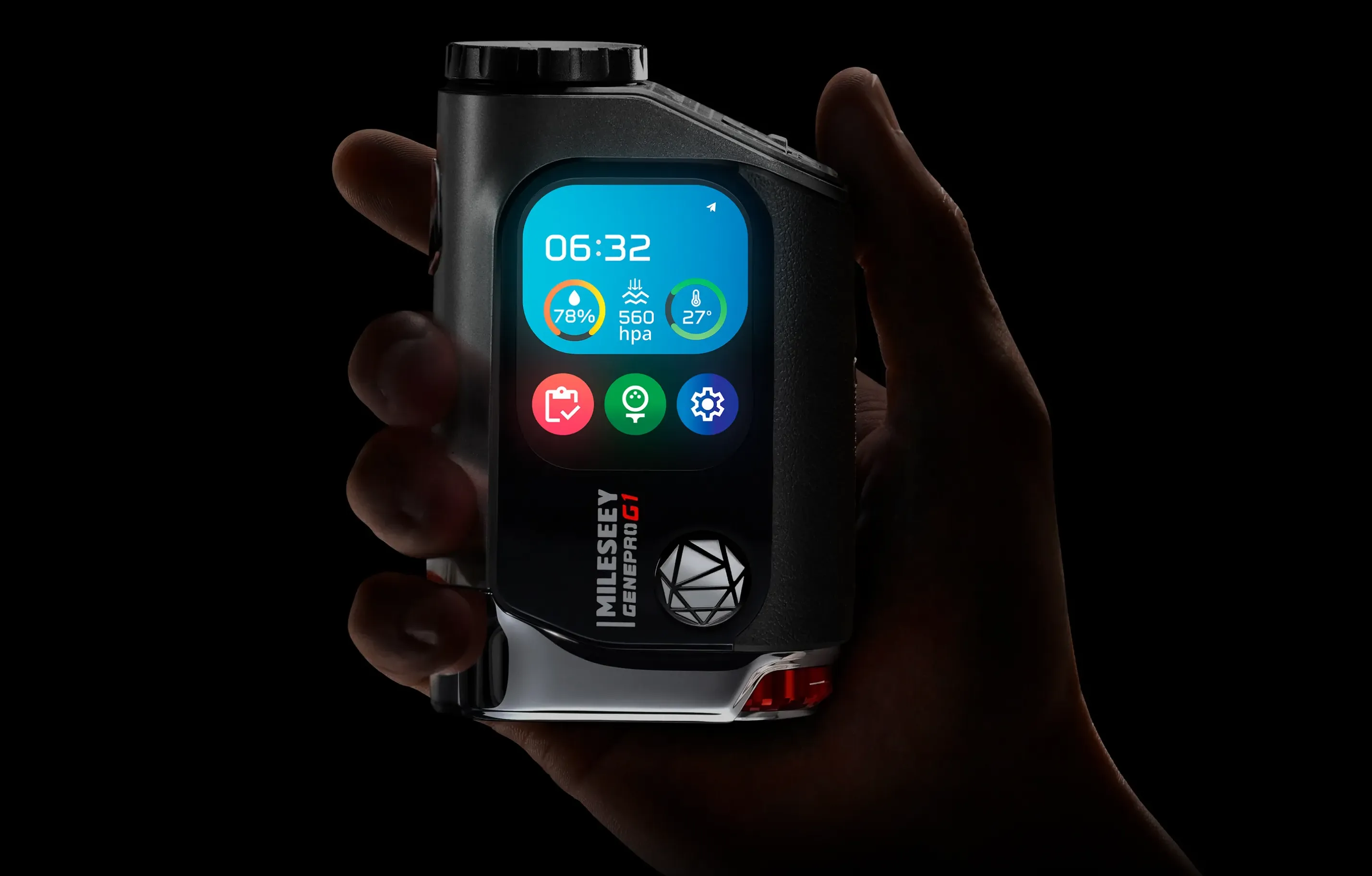
Instead of constantly remeasuring multiple targets manually, golfers can now view detailed, real-time green layouts, hazard locations, and precise distances at a single glance. Equipped with high-contrast OLED screens that remain perfectly legible under direct, harsh sunlight, these hybrid devices make data consumption effortless. By lowering the cognitive load on the player, touchscreen-integrated devices allow golfers to focus on execution rather than calculation.
| Feature / Capability | Traditional Rangefinders | Touchscreen GPS & Rangefinders |
| Measurement Scope | Distance-only line-of-sight | Integrated visual maps, green layouts & course data |
| On-Course Interaction | Repeatedly aiming & shooting during play | Critical information always visible at a glance |
| Visual Guidance | Limited to crosshair viewfinder | Interactive, multi-touch visual navigation |
| Device Overhead | High (frequent drawing and holstering) | Low (passive data display + quick touch adjustments) |
| Overall Experience | Interrupted, mechanical | Smoother, more natural flow of play |
2. The Power of Hybrid Tech: Why a Laser Rangefinder with GPS is More Precise
While touchscreens provide a macro view of the hole, the real technological breakthrough of 2026 lies in the hybrid category: the laser rangefinder with GPS. Many golfers wonder why they need both GPS and laser technology in a single device, or why this combination is vastly more precise than either system operating alone.
To understand its precision, we must look at how these two technologies solve each other’s inherent weaknesses:
-
The GPS Weakness: Traditional GPS apps and watches offer excellent hazard layouts and front/middle/back green distances. However, they cannot tell you exactly where the physical pin is cut on any given day.
-
The Laser Weakness: Traditional lasers offer pinpoint accuracy to whatever you aim at. However, if there are background trees, mounds, or shaking hands, the laser can easily lock onto the wrong target, leading to costly club-selection errors. Furthermore, lasers are useless when trying to measure a blind landing zone or a dogleg behind a hill.
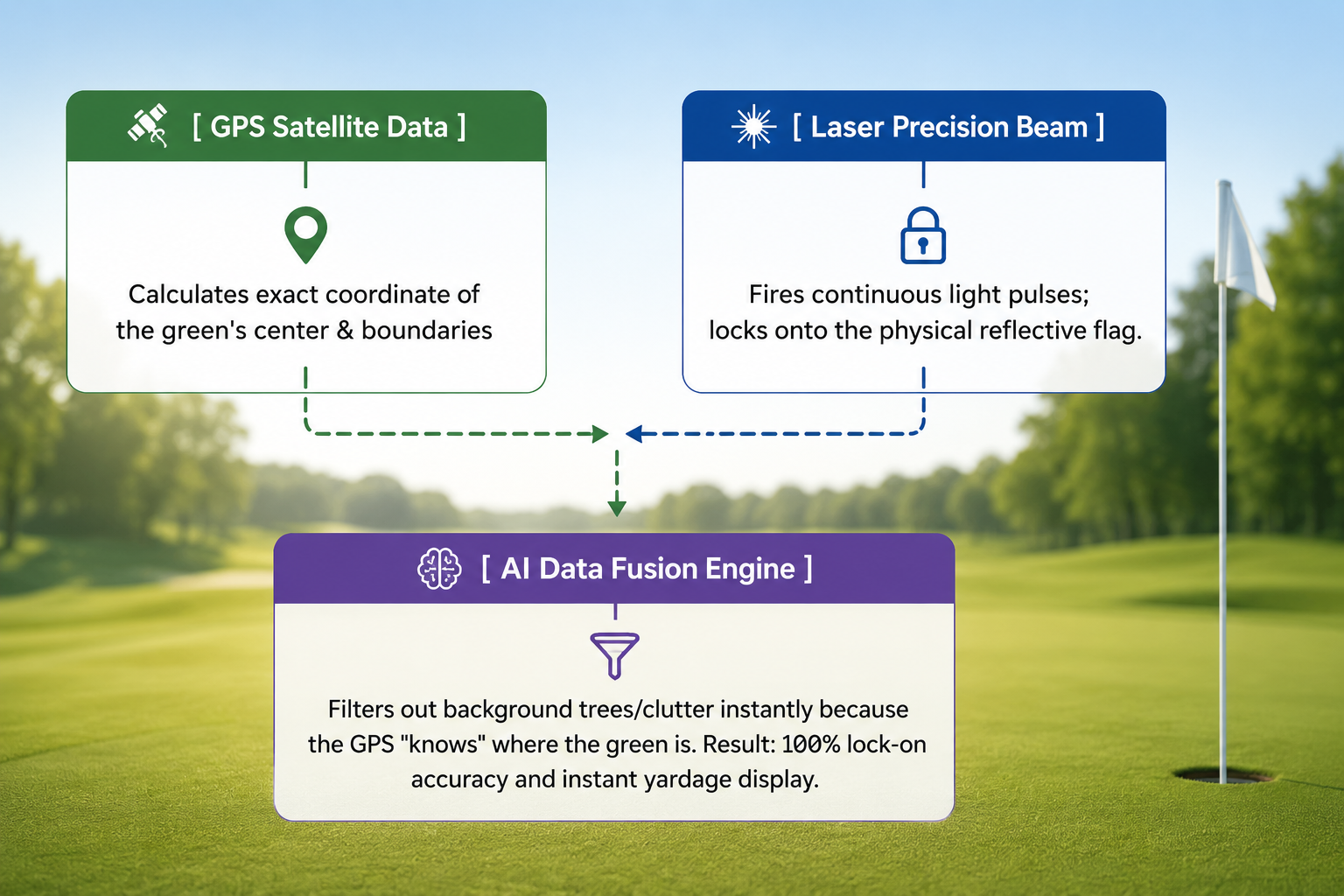
By fusing GPS data with active laser telemetry, a GPS-enabled laser rangefinder delivers unparalleled precision through three core mechanisms:
-
Instant Background Filtering (Target Lock-On): When you look through the viewfinder of a GPS-enabled laser, the device already "knows" the exact spatial coordinates of the green. When you fire the laser, the internal AI processor filters out any objects (like trees, bushes, or players on the next tee) that lie outside the green's boundaries. This ensures a near-instantaneous, 100% accurate lock on the flagstick, even with shaky hands.
-
Blind-Spot Visualization: If you are faced with an uphill shot where the flag is completely invisible, or a sharp dogleg, the laser portion of your device cannot assist you. However, the integrated GPS overlay on the viewfinder or external screen instantly shows you the exact layout of the blind spot, giving you precise yardages to clear hazards you can't even see.
-
Active Pin-Positioning Updates: Many modern courses sync their daily pin sheets directly to GPS networks. A hybrid rangefinder overlays these exact daily coordinates onto your laser view, meaning you don't just shoot the flag—you verify its precise depth on the green relative to front and back hazards.
By bridging the gap between macro-level course mapping (GPS) and micro-level target locking (laser), hybrid rangefinders remove all guesswork, ensuring that the number you see is the absolute, undeniable truth.
3. How Smarter Golf GPS Is Changing Course Management
As course technology matures, the way players interact with GPS databases has shifted from static, pre-loaded maps to active, real-time strategic assistance. Today’s golfers no longer tolerate clunky interfaces or basic front-middle-back numbers. They expect rapid access to hazard depth, green contours, landing zone safety ratings, and dynamic wind adjustments.
Because of this, modern golf course GPS systems have evolved to become highly visual, exceptionally portable, and optimized to run in the background of your pre-shot routine.
Why Handheld Golf GPS Devices Still Matter in a Wearable Era
Despite the booming popularity of smartwatches and fitness bands, many serious golfers still hold a strong preference for dedicated handheld golf GPS devices. The reason boils down to one critical factor: uncompromised visual real estate.
When navigating a complex, unfamiliar course or trying to pinpoint a specific layup zone, a tiny watch screen simply cannot convey the necessary level of detail. A premium handheld device provides a high-resolution, full-color golf GPS map that allows for precise drag-and-drop targeting.
In 2026, these dedicated handheld GPS devices have been redesigned to be:
-
Feather-Light: Engineered with slim carbon-composite frames that slip into a pocket without dragging down your swing.
-
Lightning-Fast: Powered by high-refresh-rate processors that update yardages instantly as you walk, with zero lag.
-
Sunlight-Optimized: Utilizing transflective paper-like or high-brightness OLED displays that thrive under direct glare.
-
Touch-First: Abandoning physical buttons in favor of intuitive, swipe-based navigation that mimics modern smartphones.
-
Pace-of-Play Centric: Showing only what you need, when you need it, preventing golfers from stalling on the tee box.
Modular Devices Are Solving a Real Problem
A particularly exciting offshoot of the handheld GPS trend is the rise of modular golf technology. Rather than forcing players to buy and manage separate devices for mapping, music, and analytics, manufacturers are designing unified, flexible systems.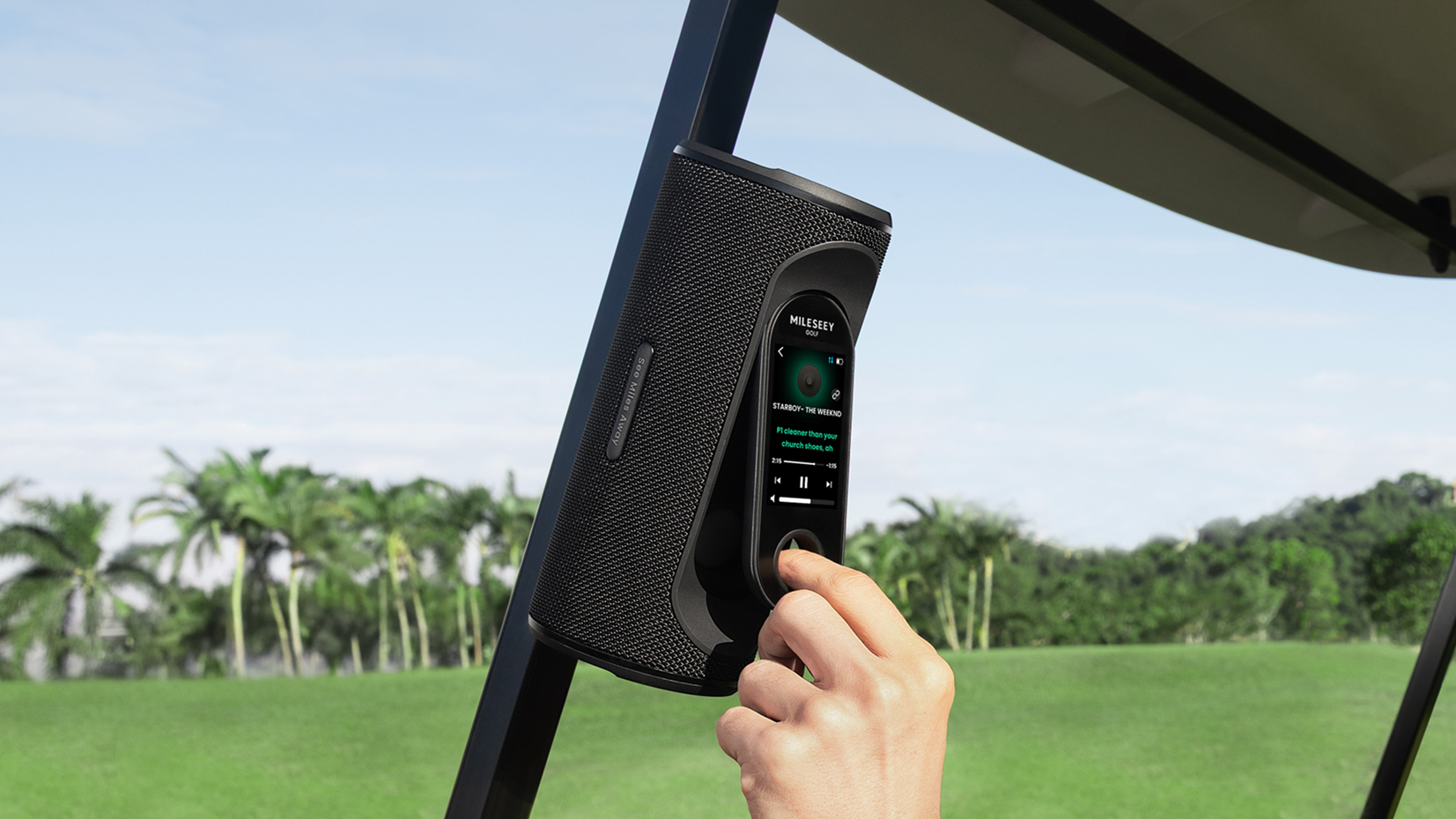 A prime example is the growing popularity of the detachable golf GPS speaker with screen. This unit magnetically mounts to a golf cart bar or pushcart, serving as a high-fidelity media speaker and a vibrant touchscreen GPS hub simultaneously. When you need to walk to your ball across the fairway, you simply pop the lightweight screen off its base and slip it into your pocket.
A prime example is the growing popularity of the detachable golf GPS speaker with screen. This unit magnetically mounts to a golf cart bar or pushcart, serving as a high-fidelity media speaker and a vibrant touchscreen GPS hub simultaneously. When you need to walk to your ball across the fairway, you simply pop the lightweight screen off its base and slip it into your pocket.This modular approach drastically reduces cart clutter, streamlines battery charging, and ensures that critical spatial information is always right at your fingertips without disrupting your flow.
4. Smart Golf Sunglasses Could Be the Real Future — Not AR Glasses
In the race to find the next paradigm-shifting golf accessory, augmented reality (AR) glasses have captured many headlines. However, when tested on a real, wind-swept, sun-drenched golf course, true AR glasses often fall short.
Most golfers do not want heavy, battery-draining glasses that paint a chaotic overlay of charts, arrows, and simulated lines across their actual field of view. Too much visual noise ruins concentration, causes eye strain over a four-hour round, and ultimately interrupts a player's athletic rhythm.
This is why smart golf sunglasses—rather than complex AR glasses—have emerged as the practical, highly adopted frontier for 2026.
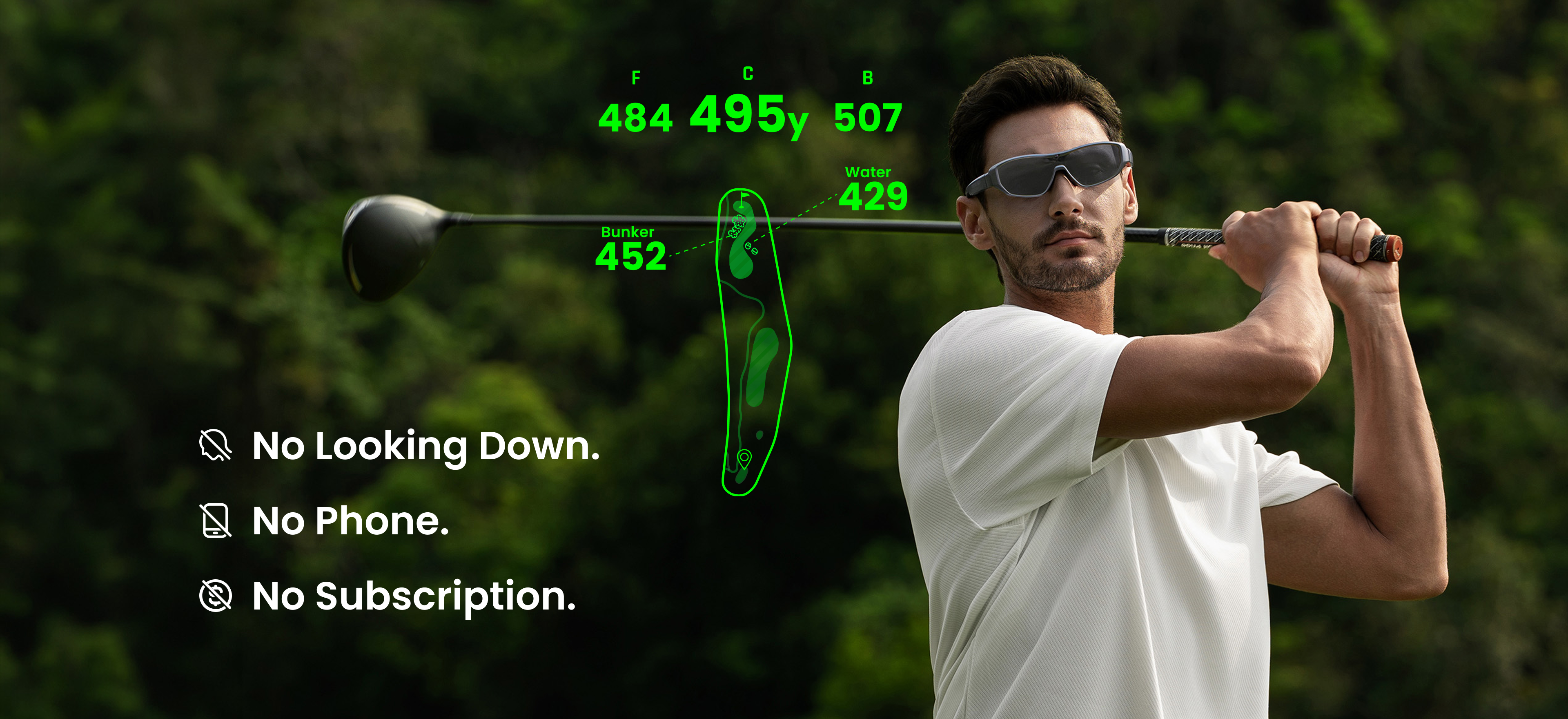
Instead of trying to digitally reconstruct or replace the golfer's natural vision, smart sunglasses are designed to complement it. They provide subtle, non-intrusive data—such as whisper-quiet audio golf course GPS guidance, glanceable basic yardages projected on the outer edge of the lens, and voice-activated golf AI assistance—without ever blocking the player's view of the ball.
Furthermore, they address the heavy hardware constraints that continue to plague full-scale AR headsets:
| Feature / Metric | AR Golf Glasses | Smart Golf Sunglasses (2026 Standard) |
| Battery Life | Heavy drainage (often failing after 3–4 hours) | Highly efficient (typically lasting 8–10+ hours) |
| GPS Map Support | Clunky, high-latency 3D rendering | Seamless, real-time audio and glanceable HUD |
| Information Display | Immersive, potentially distracting visual overlays | Minimalist, distraction-free voice or HUD guidance |
| Form Factor & Weight | Bulky, front-heavy, and prone to slipping | Lightweight, athletic frame built for high-speed swings |
| Golf Experience | Feels like operating a complex tech gadget | Feels like wearing premium, contrast-enhancing eyewear |
| Focus Retention | Can interrupt athletic concentration | Keeps the golfer locked in their natural playing rhythm |
By keeping the technology lightweight, visually passive, and practically invisible, smart sunglasses offer the modern golfer the perfect balance of data and focus.
5. AI Slope Calculation: Moving Beyond Basic Angles
For years, "slope-adjusted distance" was calculated using simple trigonometry: measuring the angle of the incline or decline and adding or subtracting a static yardage value. In 2026, this basic math is no longer sufficient for competitive or highly analytical players.
The most advanced rangefinder with slope technology now utilizes local AI microprocessors to analyze a complex matrix of real-time environmental factors, rather than just elevation alone.
When you shoot a target with a next-generation rangefinder with angle compensation, the device's internal algorithms dynamically factor in:
-1.jpeg?w=903&h=585)
-
Temperature & Air Density: Cold air is denser than warm air, creating more aerodynamic drag on the golf ball.
-
Altitude & Barometric Pressure: At higher altitudes, thinner air allows the ball to travel significantly further.
-
Humidity: Moisture levels in the air subtly affect ball lift and drag coefficients.
By compiling these data points instantly, the rangefinder calculates a hyper-accurate, custom "Play-As Distance"—the precise yardage your ball will actually perform under the exact atmospheric conditions of that specific minute.
For the golfer, this advanced environmental AI translates directly to:
-
Total Club-Selection Confidence: No more guessing whether a cold morning or high altitude requires stepping up a club.
-
Rapid Decision-Making: The AI does the environmental math instantly, allowing you to pull a club and swing without hesitation.
-
Enhanced Distance Consistency: By removing environmental variables, you can accurately evaluate your swing mechanics and build a reliable database of your true yardages.
This shift represents the evolution of golf technology from a passive, basic measurement tool into an active, intelligent, real-time decision assistant.
6. The Ultimate Destination: Invisible On-Course Technology
As we look at the trajectory of golf tech in 2026, a clear paradox emerges: the most advanced technology is the technology you notice the least.
The goal of the modern golf equipment industry is no longer to build flashier screens, louder speakers, or more complex menus. Instead, the focus has shifted entirely toward making technology feel completely natural, fluid, and integrated into the traditional spirit of the game.
Whether it is a hybrid laser rangefinder with GPS that automatically filters out background clutter, a featherweight handheld GPS map that guides your course strategy, or smart golf sunglasses that quietly whisper yardages into your ear, the philosophy remains identical: empower the player with flawless information while letting the technology fade into the background.
By making devices lighter, smarter, and physically unobtrusive, 2026 golf technology does not distract from the beauty of the game—it allows you to fully immerse yourself in it.

-12.png?w=1098&h=560)