-9.jpg?w=3840&h=1860)
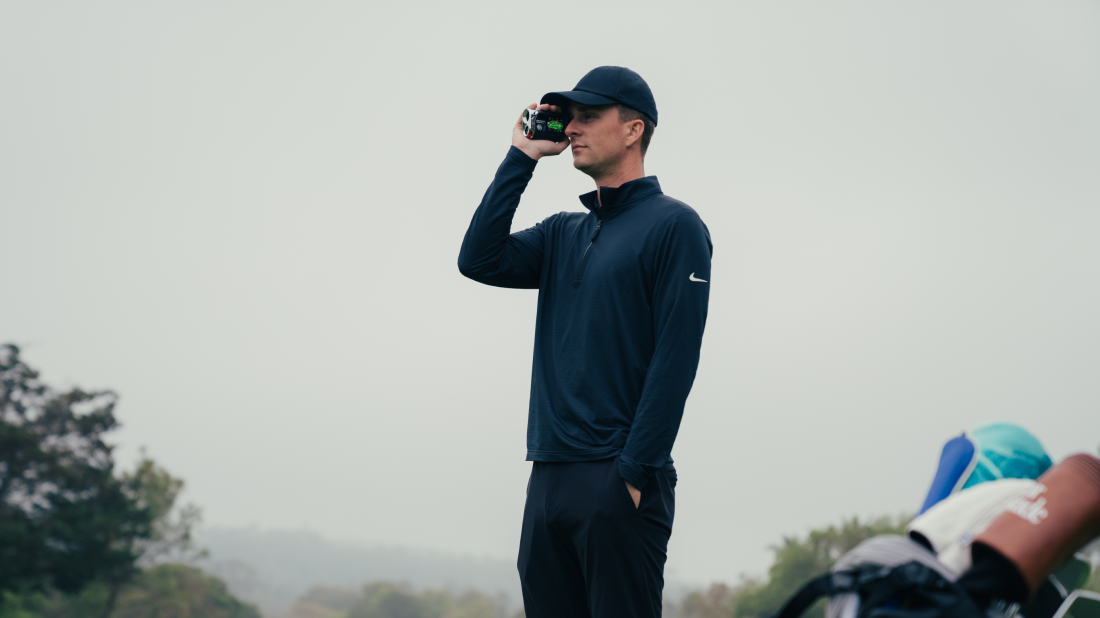
A rangefinder tells you the straight-line distance to a target. Wind changes the ball flight, not the laser reading. The mistake is treating a precise baseline as a complete “plays like” number.
Use four steps: confirm the target, read the wind along the whole flight, apply your own carry pattern, and choose a landing zone with room for error.
Step 1: confirm the baseline distance
Measure more than the pin when possible
-6.jpg?w=2560&h=1280)
Measure the pin, then obtain front and back green context from visible references, GPS, or a yardage book. Also identify the carry over any bunker or water. In wind, green depth and hazard position matter more because the dispersion pattern usually expands.
If trees sit behind the flag, repeat the reading and sweep slightly along the flagstick. Do not accept the shortest number automatically.
Step 2: read the wind in layers
Wind at your face may differ from wind above the tree line or around the green. Use several clues:
- Grass or a small pinch of dry material near the ball for local direction.
- Flag movement near the target.
- Tree-top movement for higher-flight conditions.
- Cloud movement for broader direction, when visible.
Do not convert one clue into a universal yardage adjustment. Club, launch, spin, ball speed, temperature, and shot shape all change the result.
Step 3: apply your own carry and trajectory
Build a personal wind card
On practice days, record calm carry, wind direction, estimated wind strength, club, trajectory, strike, and result. After enough comparable shots, look for patterns in your own game.
A lower-flight knockdown may reduce exposure to a headwind, but it also changes carry and stopping power. A tailwind can add distance while reducing descent angle and control. Crosswind affects both direction and curve; a fade and draw do not respond identically.
Step 4: choose a safe landing window
When uncertainty increases, aim for the part of the green or fairway that tolerates the likely miss. A tucked pin over a bunker may not be the right target even when the exact distance is known.
Use this order:
- Hazard carry and safe miss.
- Front and back of the landing area.
- Pin position.
- Your normal wind-adjusted pattern.
- Club and trajectory.
Editorial simulation: 165 yards into a headwind
Compare two decisions
This is an illustrative case, not a measured recommendation:
- Pin: 165 yards.
- Front: 150 yards.
- Back: 180 yards.
- Bunker carry: 154 yards.
- Player’s calm 7-iron carry: 165 yards, with a typical ±9-yard pattern.
- Wind: steady headwind with stronger gusts.
Option A: Aim directly at the pin with the normal 7-iron. Risk: a slightly heavy strike or gust leaves the ball in the front bunker.
Option B: Choose a lower-flight club and a center-green landing window, accepting a longer putt. Risk: a well-struck shot may finish beyond the pin, but the wider target reduces the short-hazard exposure.
The rangefinder did not select Option B. It supplied the baseline and carry numbers that made the safer trade-off visible.
Product context: target confirmation in wind
-15.jpg?w=3780&h=2040)
The MILESEEY IONME2 is a compact laser with PinPoint Green-related functions. Current official data lists 6× magnification, a 1,100-yard general range, and a 450-yard flag range. Those specifications do not guarantee a lock in every wind, rain, or background condition.
Golf Monthly praised its small body and broad functionality, while Plugged In Golf described it as pocket-sized with high-end features and said PinPoint Green can help when used correctly. In wind, the useful takeaway is not that a feature replaces judgment; it is that clear target confirmation can reduce one source of uncertainty while the golfer still handles wind and dispersion.
Browse the golf rangefinder collection only if display, stabilization, or target-confirmation needs justify another device.
What usually goes wrong
- Applying a fixed “one club per wind speed” rule to every club and trajectory.
- Reading only the wind at the ball.
- Measuring the pin but not the hazard carry or green depth.
- Turning an uncertain estimate into a precise yardage.
- Over-correcting after one poor shot.
When this method breaks down
In severe or gusting wind, normal adjustments become unreliable and safety matters more than precision. Consider a lay-up, a lower-risk target, or stopping play when conditions warrant. In competition, confirm which distance or advice functions are permitted before using them.
Bottom line
Use the rangefinder for a verified baseline, not a complete wind solution. Read wind along the flight, apply your own recorded carry patterns, and choose a landing window that protects against the likely miss. Honest uncertainty produces better decisions than a precise but invented wind formula.
-12.png?w=1098&h=560)