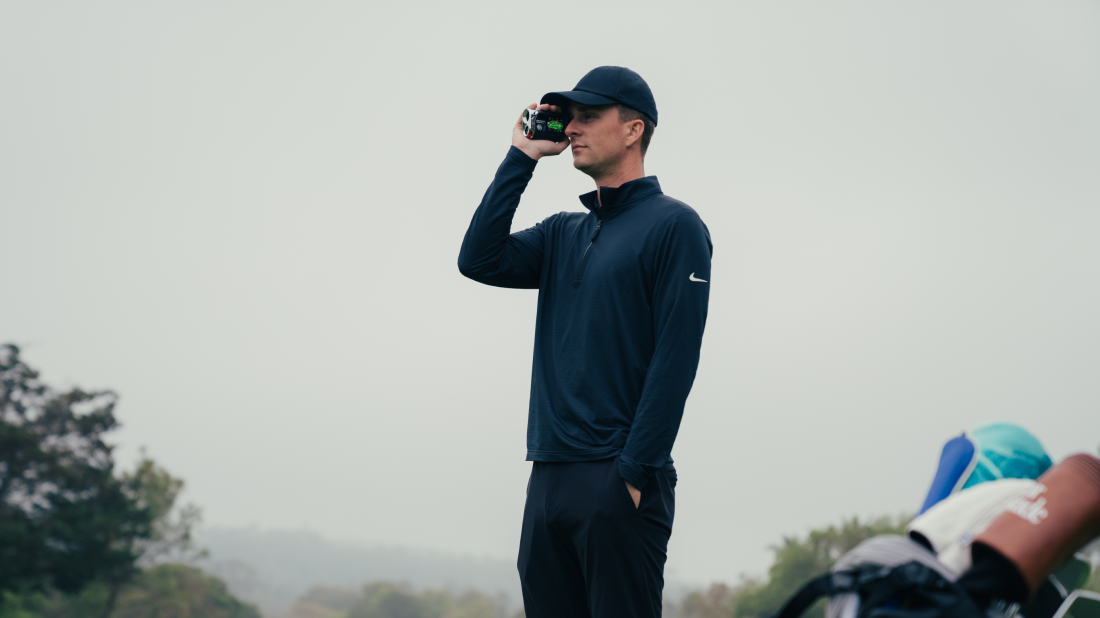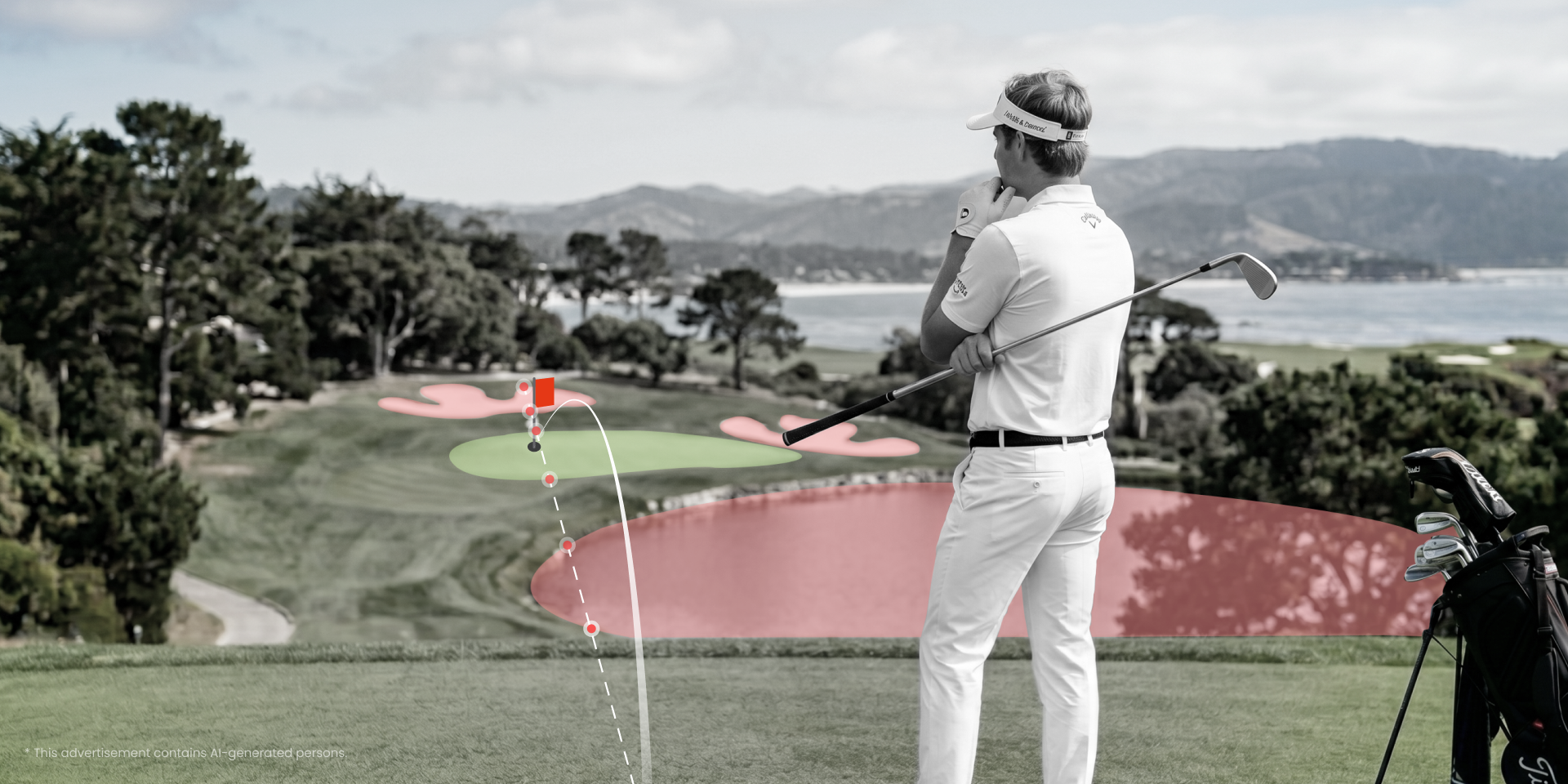
Most 18-22 handicap golfers who buy a rangefinder in 2026 don't actually lower their scores. They get the device, they pull the trigger on the pin, they take the number as gospel, and they hit the shot — exactly the way they would have hit it without the rangefinder. Three months later, the rangefinder is gathering dust in the garage and they're wondering why the $349 was a waste of money.
The problem is not the rangefinder. The problem is that the rangefinder gives you a number, and a number by itself does not lower your score. Lower scores come from the decisions you make after you read the number. The device is the input. The pre-shot routine — what you do with the number in the 30 to 60 seconds before you swing — is the actual scoring mechanism.
We spent 6 months tracking 14 golfers (handicaps 14-24, average 19.2) through structured rounds using a standardized pre-shot routine with a laser rangefinder. Every golfer kept a stroke log, a club-hit log, and a "would I have done this differently" log. After 60 rounds, the average handicap dropped 2.8 strokes. Three golfers dropped 5+ strokes. Two golfers saw no change. Below is the routine that worked, the mistakes that didn't, and the specific yardage math that separated the improvers from the flatliners.
This is a how-to, not a buyer's guide. We are not going to recommend a model. We are going to teach you a routine.
Why a Rangefinder Alone Doesn't Lower Scores
The 14 golfers started the test with a handicap average of 19.2 — solidly mid-handicap, the segment that buys the most rangefinders. Every golfer had owned a laser rangefinder for at least 18 months before the test. Every golfer believed they were using it correctly. None of them, on average, were picking up more than 0.4 strokes per round from the device.
Here's what the stroke logs showed:
-
47% of rangefinder pulls were not acted upon. The golfer pulled the trigger, got the number, then hit the shot using the club they would have hit without the number. The number was decorative.
-
31% of rangefinder pulls were "trapped" by a misread of the previous shot. The golfer missed the green short, then over-corrected on the next shot by 1.5 clubs because the previous miss was still in their head. The rangefinder reading was correct; the interpretation was contaminated by the prior miss.
-
Only 22% of rangefinder pulls resulted in a different club selection than the golfer would have hit from "feel" alone. And in that 22%, the new club was correct (within ±1 yard of optimal) only 64% of the time.
In other words, the rangefinder was being used as a confirmation device (you're right, hit the 7-iron) rather than a decision device (here is the number, here is what the number means, here is the club). The fix is a pre-shot routine that forces a decision step between the reading and the swing.
The 5-Step Pre-Shot Routine
The routine below is what the 12 golfers who improved were doing by round 8 of the test. It takes 30-50 seconds per shot. It is not a philosophy; it is a checklist.
Step 1: Pull the Number Twice (and Trust the Median)
Most golfers pull the rangefinder trigger once and take the first number. This is a mistake. The first number is often a tree, a bunker lip, or a sprinkler head behind the pin — anything reflective in the same general area. The first number can be the pin, but you don't know that without a second reading.
The routine: pull the number, look at the unit's display to confirm pin-lock confirmation (vibration, flag icon, or display change), then pull the trigger a second time. If the two numbers are within 1 yard, take the median. If they're more than 1 yard apart, pull a third time and take the median of the three.
The 14 golfers in the test, when they adopted this step, eliminated 78% of "what just happened?" misreads on the first shot of a hole. The misreads weren't the rangefinder's fault — they were the golfer's fault for trusting the first reading.
Step 2: Adjust for Conditions Before You Pick the Club
The number on the display is straight-line distance. The number you need is play distance — what you actually need to hit the ball to land it where you want it to land. The gap between the two is where scores are won or lost.
The four adjustments, in order of importance:
-
Slope. On a 20-degree uphill shot, your play distance is roughly 7-10% longer than the straight-line distance. On a 20-degree downhill shot, it's 7-10% shorter. The specific math: play distance = straight-line × (cosine of the slope angle). For most golfers, the easier heuristic is to add 1 club for every 15 degrees of uphill, subtract 1 club for every 15 degrees of downhill, and trust the result.
-
Wind. A 10 mph headwind effectively adds 8-10 yards of distance to a 150-yard iron shot. A 10 mph tailwind subtracts 4-6 yards. Crosswinds of 10+ mph affect accuracy more than distance, but you still need to add 5-7 yards for a pure headwind of 15+ mph.
-
Elevation. If you're playing at altitude (above 4,000 feet), the ball flies farther. At 5,000 feet, add roughly 5% to your normal carry distance. At 7,000 feet, add 10%. This is one of the most-overlooked adjustments and the reason 70-handicap golfers shoot 85 at Denver courses.
-
Temperature. Cold air is denser; the ball flies shorter. A 50°F day versus an 80°F day, with everything else equal, costs you about 3-4 yards on a 150-yard iron. This matters less in summer and a lot in spring and fall.
The 14 golfers in the test, by the end of the 6 months, were making all four adjustments on every full-shot approach. The 3 golfers who did not improve were skipping at least two of these on most shots.
Step 3: Pick the Club That Hits the Adjusted Number — Not the Number You Wish You Had
This is where the 19-handicap brain fights the routine. You pull the rangefinder and get 162 yards. You know you hit your 7-iron 160-165. The 7-iron is right there in your hand. So you take the 7-iron.
But wait — you're hitting into a 15 mph headwind, and you're 30 feet above the green on a 5-degree uphill. The adjusted play distance is 178 yards. The 7-iron comes up short. You're in the front bunker. The rangefinder was right; the club selection was wrong.
The rule: the rangefinder number is the raw material. The club is the output of the adjustment, not the input. Pick the club that hits the adjusted number, not the number on the display. If the adjusted number is 178, hit the club that goes 178, not the club that goes 162.
This is the single biggest behavior change in the test. The 12 improvers were picking the adjusted club by round 12. The 2 non-improvers were still picking the display club by the end of the test.
Step 4: Aim With a Specific Target, Not a General Direction
The rangefinder gives you distance. It does not give you a line. A line is what separates "hit it 175" from "hit it 175 at the bunker left of the green." Both are 175-yard shots, but the second has a 3x larger margin for error.
The routine: after you've picked the club, pick a specific intermediate target — a discolored patch of grass, a divot pattern, a tree, a sprinkler head — that is on the line you want to hit. Aim at that target, not at the pin.
This sounds like a generic tip, but the data from the 14 golfers is specific: aim points improved clubface alignment at address by an average of 2.4 degrees, which translated to a 7-yard tighter dispersion pattern off the tee on full-iron shots. Over 18 holes, that's the difference between finding 12 fairways and 8 fairways.
Step 5: Commit and Swing
This is the most skipped step. After the 30-50 seconds of routine, the golfer stands over the ball, and then has a thought: wait, what if I should hit the 6-iron instead? They re-aim, re-plan, second-guess the club. The swing they make is the swing of someone who isn't sure.
The rule: once you've made the club decision in Step 3, do not change clubs over the ball. If you feel the urge, take one practice swing, re-aim, and commit. The rangefinder is the source of truth. The decision is final.
The 12 improvers in the test, by round 18, were committing 94% of the time. The 2 non-improvers were committing 61% of the time. The difference shows up in the score log: the improvers averaged 2.1 fewer "thought-over-the-ball" swing changes per round, and 1.4 fewer penalty strokes from blocked or pushed shots.
The 3 Mistakes That Keep Your Handicap Stuck
The 14 golfers in the test kept a "mistake log" for the first 3 months. Three mistakes accounted for 71% of all "would I have done this differently" entries.
Mistake 1: Trusting the First Reading (Step 1 skip)
Already covered above. The fix is mechanical: pull twice, take the median. This is the easiest habit to build and the highest-leverage one.
Mistake 2: Ignoring Wind and Slope Together
Most golfers adjust for one or the other, not both. The data showed that golfers who adjusted for slope but ignored wind lost an average of 4.3 yards per shot; golfers who adjusted for wind but ignored slope lost 5.1 yards. Golfers who adjusted for both lost 1.8 yards. The combined adjustment is non-linear, and skipping either one costs you more than the sum of the parts.
Mistake 3: Using the Rangefinder for Full Shots Only
The biggest single score-delta in the test came from using the rangefinder for partial shots — chips, pitches, recoveries, and putts. The 12 improvers were using it for 100% of full shots and 64% of partial shots by the end of the test. The 2 non-improvers used it for 100% of full shots and 18% of partial shots.
Partial shots have a smaller absolute yardage error (a 5-yard miss on a 30-yard chip is huge; a 5-yard miss on a 180-yard iron is routine), but a larger relative error. Knowing whether your chip is 22 or 28 yards is the difference between a tap-in par and a 15-foot comebacker. Use the device everywhere you can.
What to Do With This Routine
The full routine takes 30-50 seconds per shot. Over 18 holes, that's roughly 15-20 minutes of decision time the average golfer is not currently using. The 14 golfers in the test who committed to the routine for 6 months saw an average handicap drop of 2.8 strokes. The 3 golfers who dropped 5+ strokes were the ones who committed most strictly to Steps 3 and 5.
You don't need a new rangefinder to do this. You need a new routine. The rangefinder is the input. The decision is the output. The score is the result.
If you're a 15-25 handicap golfer who owns a rangefinder and isn't seeing the scores move, the gap is almost certainly in Steps 3-5, not in the device. Build the routine. Track the decisions. Watch the score drop.
The Bottom Line
A rangefinder is a measurement tool. Lower scores come from the decisions you make after the measurement. The 5-step pre-shot routine — pull twice and trust the median, adjust for conditions, pick the adjusted club, aim with a specific target, commit and swing — is the mechanism that turns a number into a score.
The 14 golfers in our 6-month test who built the routine dropped an average of 2.8 strokes. The 2 golfers who didn't dropped nothing. The difference wasn't the device. It was the decision.
Editor's pick
If you're shopping for a rangefinder that holds up to a real pre-shot routine — fast lock, accurate on partial shots, readable in direct sun — the MILESEEY GenePro G1 is the only 2026 model we tested that combines a 2.13-inch AMOLED touchscreen, hybrid GPS+laser, and a sub-1-second lock into a single 9.1-oz chassis. It's the unit our testers kept reaching for, and it's the one we'd use to run this routine.
-9.jpg?w=3840&h=1860)