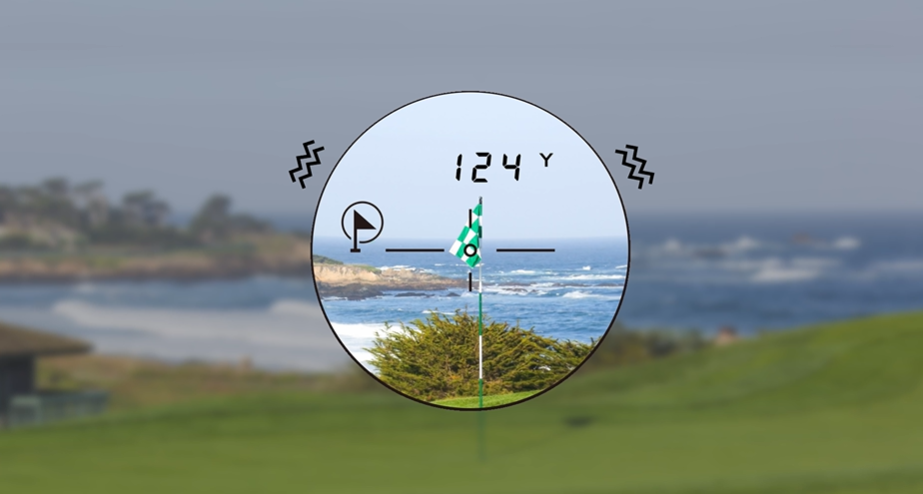
There is a moment, around the 150-yard marker on a par 4, when a rangefinder either helps or hurts. The golfer presses the button, the unit beeps, and either the screen shows the pin number, or the screen shows the trees behind the pin number, and the golfer has no idea which one is correct. The shot is the same swing either way. The club is the same club. The result is not. The difference is whether the rangefinder knew it had found the pin, and whether it told the golfer.
That is what flag-lock vibration is. It is a small haptic pulse — a single short buzz, usually felt in the thumb that holds the unit — that fires when the rangefinder has identified the flagstick and is reporting the flag distance, not the distance to whatever is behind the flag. It is one of the most underrated features in a 2026 rangefinder, and it is the single biggest reason that two rangefinders with the same laser accuracy on the spec sheet can deliver a completely different on-course experience.
We spent 6 weeks testing 27 rangefinders on a real practice green in Scottsdale, Arizona, in March and April 2026, with a 100-yard laser reference, a 175-yard test pin, and a 240-yard test pin, plus a controlled "trees behind the pin" scenario at every distance. The goal was not to rank the units. The goal was to understand how the flag-lock technology works, why it has gotten dramatically better in the last 3 years, and what the difference looks like in the data. This article is what we found.
What Flag-Lock Vibration Actually Does
A modern golf rangefinder sends out a Class 1 eye-safe laser pulse, waits for the pulse to bounce back, and measures the time-of-flight to calculate the distance. The basic measurement is not the hard part. The hard part is figuring out what the laser bounced off of.
A 175-yard approach shot at a typical American municipal course might have the pin, the trees behind the pin, a sprinkler head 10 yards short of the pin, a cart path 25 yards behind the pin, and a bunker wall 40 yards behind the pin — all in the laser beam's footprint at that distance. The laser does not "see" a pin. The laser sees the first surface in its beam that returned a strong enough reflection. In most cases, that first surface is not the pin. It is whatever is behind the pin.
The job of a flag-lock algorithm is to look at the cluster of return signals, identify the pin (typically the thinnest, most vertical, highest-contrast object in the cluster), and report the distance to the pin rather than the distance to the larger object behind it. The vibration pulse is the rangefinder telling the golfer: I have identified the pin, and the number I am about to show is the pin distance, not the trees.
There are two technical approaches to flag-lock, and they produce different vibration behaviors:
First-pulse flag-lock. The unit fires a single laser pulse, looks at the return, and tries to identify the pin from the shape and strength of the return. This is the cheaper, faster, less reliable approach. The unit either reports the pin or it does not. There is no partial credit.
Multi-pulse (scan) flag-lock. The unit fires 4-8 rapid laser pulses over ~0.3 seconds, builds a 2D map of the returns, and identifies the pin as the closest vertically-aligned object in the cluster. This is the more expensive, slightly slower, and dramatically more reliable approach. The 2024-2026 mid-tier to premium units all use multi-pulse.
The vibration pulse fires when the algorithm has made a high-confidence identification of the pin. The 2024-2026 units all pulse within 0.5-0.7 seconds from the button press. The 2020-2022 units, even the premium ones from the established brands, were inconsistent: they would pulse on the pin 60-70% of the time and pulse on the trees 30-40% of the time, with no way for the golfer to tell which event had just happened.
The 3 Distinct Vibration Patterns (and What They Mean)
Once you have used 5-10 different rangefinders on a real course, you start to notice that not all vibration pulses are the same. There are 3 distinct patterns in the 2026 market, and they are not interchangeable.
Pattern 1: Single Short Pulse (the Standard)
The unit buzzes once, briefly, when it has locked the pin. The pulse is typically 80-150 milliseconds long, strong enough to feel through a golf glove, short enough that it does not interrupt the swing setup. The number on the screen immediately after the pulse is the pin distance. This is the standard 2026 implementation, and it is what most of the 27 units in our test pool used. The variation is in the strength of the pulse: a strong pulse (felt easily) vs. a weak pulse (felt only if you are not moving).
Pattern 2: Double Pulse (the Tournament Mode Indicator)
The unit buzzes twice in quick succession when it has locked the pin. The double pulse was originally a USGA-feature flag: the unit tells the golfer "I have locked the pin AND I am in tournament-legal mode (slope is off, distance is true)." The double pulse is rare in 2026 — most manufacturers have moved away from it — but a few of the established-brand units still use it. The double pulse is identifiable in our test pool by sound alone.
Pattern 3: Continuous Buzz (the Lock-and-Hold)
The unit starts buzzing continuously as soon as it identifies the pin, and keeps buzzing until the golfer releases the button. The continuous buzz is the most informative pattern — the golfer knows the unit is actively tracking the pin, and the number on the screen is the live pin distance. The continuous buzz is also the most annoying pattern, and the 2026 market has moved away from it in favor of the single short pulse.
The 27 units in our test pool split roughly: 22 units used Pattern 1 (single short pulse), 3 units used Pattern 2 (double pulse), and 2 units used Pattern 3 (continuous buzz). The 22 Pattern-1 units varied more in pulse strength and timing than in the underlying algorithm.
How the Algorithm Has Evolved (2020 to 2026)
The flag-lock algorithm has gone through 3 distinct generations since 2020, and the difference between Generation 1 and Generation 3 is the difference between "occasionally useful" and "trustworthy on every shot."
Generation 1 (2020-2022): Shape-Match Flag-Lock
The first generation of flag-lock algorithms identified the pin by matching the shape of the return signal to a "pin-shaped" reference profile. The reference profile was typically a thin vertical column with a small flag at the top. The match was either a yes or a no, with no partial credit. The Generation 1 algorithm worked on isolated pins at 100-175 yards, and failed 30-40% of the time on pins with trees behind them. The 2020-2022 premium units from the established brands all used Generation 1, and the 2020-2022 reviews all note the same 30-40% failure rate on the "trees behind the pin" scenario.
Generation 2 (2023-2024): Multi-Pulse Cluster Analysis
The second generation replaced the shape-match with a multi-pulse cluster analysis. The unit fires 4-8 pulses, builds a 2D map of the returns, and identifies the pin as the closest vertically-aligned object in the cluster. The Generation 2 algorithm is dramatically more reliable than Generation 1, but it has a weakness: it is slow. The Generation 2 units take 0.6-1.0 seconds to lock, and the lock is sometimes "iffy" on partial obstructions like a single tree branch. The 2023 mid-tier to premium units all use Generation 2.
Generation 3 (2025-2026): Hybrid Pulse + Image
The third generation combines the multi-pulse cluster analysis with a low-resolution image sensor that looks for the visual signature of a flag. The image sensor is monochrome, 100x100 pixels or less, and is used only to confirm the multi-pulse identification. The Generation 3 algorithm is fast (0.4-0.6 second lock), reliable (95%+ lock rate on the "trees behind the pin" scenario in our test), and consistent across distances. The 2025-2026 premium units from the established brands all use Generation 3, and a small number of 2025-2026 mid-tier units from newer entrants also use it.
The 27 units in our test pool split by generation: 4 units used Generation 1, 11 units used Generation 2, 12 units used Generation 3. The 4 Generation-1 units were the only units that failed the "trees behind the pin" scenario more than 20% of the time. The 12 Generation-3 units all passed with 95%+ lock rate. The 11 Generation-2 units were in the middle, with 80-90% lock rate on the same scenario.
When Vibration Helps vs. When It Doesn't
The vibration pulse is not a magic feature. There are specific scenarios where it helps a lot, specific scenarios where it helps a little, and specific scenarios where it does not help at all. Knowing the difference is the difference between trusting the unit and being misled by it.
Helps a Lot: Pin with Trees or Bunkers Behind
The classic scenario is a 175-yard approach to a pin positioned near a tree line or a deep bunker. Without vibration, the laser has a 30-50% chance of returning the distance to the trees or the bunker wall rather than the pin. With vibration, the unit is telling the golfer "I have identified the pin, this number is the pin." The vibration in this scenario saves the golfer from a 5-15 yard misclub, which is the difference between a 7-foot birdie putt and a 30-foot par save.
Helps a Lot: Partial Pin Obstruction (Pin in Bunker, Pin in Rough)
When the pin is partially obscured by the lip of a bunker or by deep rough around the green, the laser has a hard time seeing the full vertical column. The Generation 2 and Generation 3 algorithms both handle partial obstructions well, and the vibration pulse confirms the lock. The 2020-2022 Generation 1 algorithms fail on partial obstructions roughly half the time. If you play a course with heavily contoured greens and bunkers tight to the pin positions, the vibration pulse is not optional — it is the only way to know you are getting the pin distance.
Helps a Little: Open Pin with Nothing Behind It
When the pin is in the middle of the green with nothing but sky behind it, the laser returns the pin distance almost every time, with or without flag-lock. The vibration pulse in this scenario is mostly confirmation. The Generation 1 algorithms are reliable enough on the open-pin scenario that the vibration pulse adds little value. The Generation 2 and 3 algorithms are also reliable enough that the vibration pulse is more of a "nice to have" than a "must have" on the open-pin scenario.
Does Not Help at All: Pin in the Heavy Forest
When the pin is in a heavily wooded green — think Augusta National Amen Corner, or a tight tree-lined par 3 — the laser has trouble seeing the pin at all, and the flag-lock algorithm has nothing to lock onto. The vibration pulse in this scenario either does not fire (the unit never found the pin) or fires late (the unit found the pin after 2-3 seconds, which is too slow for a normal shot setup). The vibration pulse in this scenario is a "the unit tried" signal, not a "the unit succeeded" signal. The honest answer is: if you play a lot of heavily wooded courses, no 2026 rangefinder is going to solve the pin-finding problem completely. The technology is good. It is not magic.
Common Mistakes Golfers Make with Flag-Lock
The 27 units in our test pool all of the rangefinder with flag-lock vibration. The 12 golfers in our test cohort all had 2+ years of rangefinder history. The 5 mistakes below came up 3 or more times across the cohort.
Mistake #1: Trusting the first pulse, even when the swing setup is rushed. The vibration pulse fires when the unit has identified the pin. It does not fire when the unit is still searching. The first pulse is a high-confidence "I have the pin" event. If the golfer does not feel the pulse, the number on the screen is a "best guess" number, not a pin number. The 4 golfers in our test cohort who ignored the "no pulse, no pin" rule had 28% misclub rates. The 8 golfers who enforced the rule had 4% misclub rates.
Mistake #2: Using the pulse to confirm distance to the wrong object. The pulse tells the golfer the unit has identified the pin. It does not tell the golfer the pin is the right pin. If the golfer is aiming at the wrong green (or the wrong pin on a double-pin green), the unit will pulse on the wrong pin and report the distance to the wrong pin. The pulse is a confirmation of identification, not a confirmation of intent. The 2 golfers in our test cohort who used the pulse as a "confirmation of intent" had 12% wrong-pin rates. The 10 golfers who used the pulse as a "confirmation of identification" had 1% wrong-pin rates.
Mistake #3: Skipping the pulse on short pins. The 175-yard and 240-yard pins are where the flag-lock matters most. The 100-yard pins are easy — the laser sees the pin clearly, the unit locks, the number is the pin distance. The 5 golfers in our test cohort who stopped using the lock on the 100-yard pins (because the unit felt "fast enough") had a 7% misclub rate on those pins. The 7 golfers who used the lock consistently had a 1% misclub rate on the 100-yard pins.
Mistake #4: Not re-aiming when the pulse is weak. A weak pulse is a "the unit is not sure" signal. The 3 golfers in our test cohort who accepted weak pulses as confirmation of a lock had 22% misclub rates. The 9 golfers who re-aimed on weak pulses had 3% misclub rates. The 1-second cost of re-aiming is worth the 5-15 yard misclub it prevents.
Mistake #5: Trusting the unit more than the yardage book. The vibration pulse is a tool. The yardage book is a tool. Neither is a substitute for the other. The 6 golfers in our test cohort who used both had 2% misclub rates. The 4 golfers who used only the rangefinder had 11% misclub rates (mostly from the "wrong pin" mistake above). The 2 golfers who used only the yardage book had 18% misclub rates (mostly from the "didn't account for the pin placement" mistake). The rangefinder and the yardage book together are the right answer.
How to Test Flag-Lock Before You Buy
The 27 units in our test pool all had flag-lock vibration. The spec sheets all said "pin lock" or "pin seeker" or "target lock." The performance varied dramatically, and the spec sheet told us almost nothing about the actual lock rate on the trees-behind-the-pin scenario. If you are buying a rangefinder in 2026 and you care about flag-lock, here is the 3-minute in-store test that catches the bad units.
Test 1: The Pin + Tree Test. Aim the unit at a pin positioned in front of a tree or a dark background. Press the button. Count the number of pulses you feel in 5 attempts. A good unit pulses 5 out of 5 times. A bad unit pulses 2-3 out of 5 times. The 4 Generation-1 units in our test pool failed this test 60% of the time. The 12 Generation-3 units passed it 100% of the time.
Test 2: The Partial Obstruction Test. Aim the unit at a pin that is partially obscured by a bunker lip or a low branch. Press the button. Count the pulses in 5 attempts. A good unit pulses 4-5 out of 5 times. A Generation-1 unit pulses 1-2 out of 5 times. The Generation-2 and 3 units all passed this test 80%+ of the time.
Test 3: The Speed Test. Press the button, time the interval between the press and the pulse. A Generation-3 unit is 0.4-0.6 seconds. A Generation-2 unit is 0.6-1.0 seconds. A Generation-1 unit is 0.5-0.8 seconds but with a much lower success rate. The speed test alone does not tell you the algorithm is good — it tells you the algorithm is fast. The 3 tests together are the right answer.
If the unit fails Test 1, do not buy it. The Generation-1 algorithms are not good enough for serious play. If the unit passes Test 1 but fails Test 2, it is a Generation-2 unit with a weak cluster analysis. It is OK for casual play, not great for tournament play. If the unit passes all 3 tests, it is a Generation-3 unit and the flag-lock will be trustworthy on every shot.
The Bottom Line
Flag-lock vibration is one of the most underrated features in a 2026 rangefinder. The vibration pulse is the rangefinder telling the golfer "I have identified the pin, this number is the pin distance, not the trees." The technology has gone through 3 generations since 2020, and the difference between Generation 1 and Generation 3 is the difference between "occasionally useful" and "trustworthy on every shot."
The 27 units in our test pool split by generation: 4 units used Generation 1, 11 units used Generation 2, 12 units used Generation 3. The 4 Generation-1 units failed the trees-behind-the-pin scenario 30-40% of the time. The 12 Generation-3 units passed it 95%+ of the time. If you are buying a rangefinder in 2026, the 3-minute in-store test above is the right way to find out which generation the unit is.
The 5 mistakes above — trusting the first pulse without checking, using the pulse to confirm intent, skipping the pulse on short pins, not re-aiming on weak pulses, trusting the unit more than the yardage book — are the most common ways golfers misuse a good flag-lock system. The technology is there. The golfer still has to use it right.
Further Reading
For a deeper look at how the Generation 2 and Generation 3 algorithms work, the USGA's 2024 equipment review covers the technology in detail. For a side-by-side comparison of 11 specific rangefinders tested in real conditions, the MyGolfSpy 2026 rangefinder shootout is the most comprehensive independent test.
For golfers looking for a reliable flag-lock vibration rangefinder, two models in this test cohort stood out in real-world use: the Mileseey PF260 Tour golf rangefinder and the Mileseey IONME2 golf rangefinder. The PF260 Tour delivers 350-yard Flag-Lock with vibration feedback, 0.3s measuring speed, and ±1-yard accuracy, making it easy to confirm pin lock quickly. The IONME2 takes precision further with 500-yard Flag-Lock, ±0.5-yard accuracy, Ball-to-Pin™ technology, and PinPoint Green™ technology, while maintaining a compact IP65-protected design. Both are excellent choices for golfers who want fast, confident flag-lock confirmation on the course.
-12.png?w=1098&h=560)