
A laser rangefinder and a GPS device do not provide the same information. Laser measures a visible object. GPS provides course position and shape. A hybrid combines both, but its value depends on whether that consolidation makes your routine clearer.
Our view: hybrid is best for golfers who repeatedly need target detail and hole context in the same decision. Separate devices remain better when a golfer wants a simple laser, already owns a GPS watch, or shares audible GPS information from a cart.
What each setup answers
Laser-only
Best question: “How far is it to that visible pin, bunker lip, tree, or lay-up marker?”
Strengths are direct targeting and a focused interface. The limitation is line of sight; a laser cannot map a blind hazard or show the overall green shape.
Standalone GPS
Best question: “Where am I relative to the hole, green, and mapped hazards?”
GPS works without aiming and can give front-middle-back context. It usually does not give a direct laser measurement to a visible object, and course mapping or satellite conditions can affect the experience.
Hybrid laser plus GPS
Best question: “What is the precise visible target, and how does it fit the hole?”
A hybrid reduces switching between devices. Its trade-offs are more interface complexity, charging demand, and the need to verify the selected hole and data source.
A practical setup matrix
| Your normal round | Best starting setup | Main trade-off |
|---|---|---|
| Familiar, open home course | Laser only | Limited blind-hole context |
| Walking with an existing GPS watch | Watch + simple laser | Two devices to charge/read |
| Unfamiliar or blind-shot courses | Hybrid laser + GPS | More complex interface |
| Cart golf with shared information | Laser + GPS speaker | More than one device |
Count decisions, not devices
Ask how many times per round you switch screens, reach for a phone, or doubt which number answers the shot. A two-device setup is not automatically worse; it is worse only when the handoff creates friction.
Hybrid example: GenePro G1
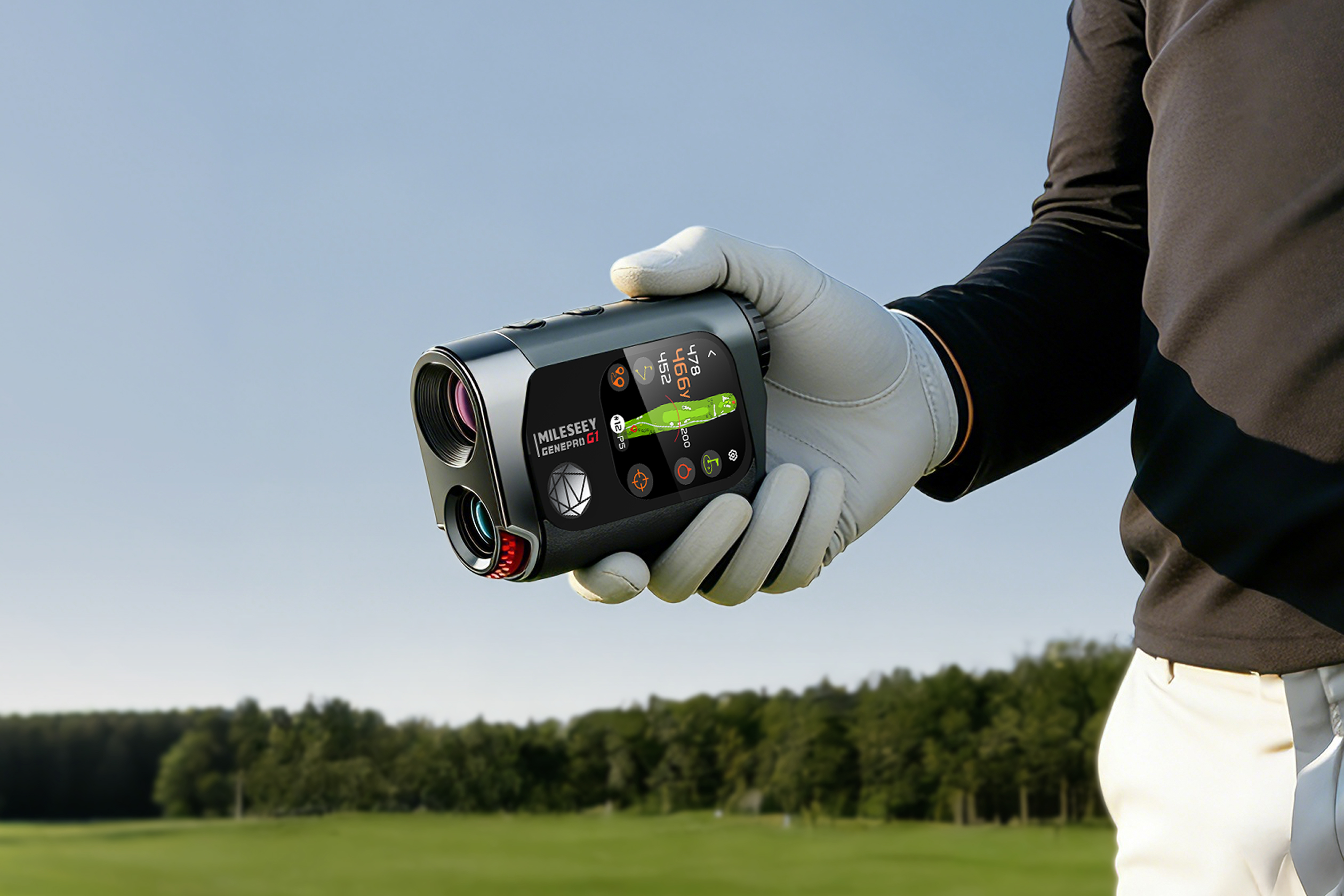
The MILESEEY GenePro G1 combines laser measurement, on-device GPS mapping, and an AMOLED touchscreen. Current official data lists a 1,300-yard general measuring range, a 600-yard flag range, IP65 protection, and a 1,000 mAh USB-C rechargeable battery. These are manufacturer specifications, not our comparative test results.
Plugged In Golf reported quick and accurate laser performance and GPS readings usually within 1–2 yards of a trusted device or course yardage. Golf Monthly praised the bright AMOLED display and full-hole view while noting occasional lag and automatic-hole-change problems. The practical implication is that hybrid information is powerful when the golfer verifies the hole and uses laser and GPS for their separate jobs.
Separate-device example: IONME2 plus GPS
-13.jpg?w=3840&h=2040)
The MILESEEY IONME2 is a compact laser that can be paired with a watch, phone app, handheld GPS, or cart display. Plugged In Golf described it as pocket-sized with high-end functions and found PinPoint Green potentially useful when applied correctly. This setup keeps laser and map interfaces separate, which some golfers find clearer.
-10.png?w=2204&h=1240)
For cart-based audio and front-middle-back information, the MILESEEY GeneSonic Pro combines a detachable GPS unit with a speaker. Golf Monthly identified the detachable GPS as the key innovation, while Plugged In Golf praised clear, loud audio and operation without a phone or subscription. It fits a cart workflow, but audio etiquette and another charging routine remain real considerations.
Explore the golf GPS collection or golf rangefinder collection only after deciding which question needs priority.
Editorial simulation: a blind approach
How the setups change the decision
Assume a blind approach with a visible tree as the only laser target. A laser can confirm the tree distance but not the green shape behind it. GPS can show front-middle-back and hazards but not the exact tree. A hybrid can present both.
The correct choice still depends on dispersion. If the safest landing window is center green, GPS context may be enough. If the tree defines a carry or lay-up, the laser adds necessary detail. The hybrid’s value is not a magically better number; it is fewer gaps between those questions.
When hybrid does not win
Hybrid is unnecessary when a golfer plays a familiar open course and wants only pin distance. It is also a poor fit for someone who dislikes touchscreens or forgets to charge connected devices. A dedicated laser plus an existing watch may be cheaper and easier to troubleshoot.
Bottom line
Choose hybrid when laser target detail and GPS course context repeatedly belong in the same decision. Choose separate devices when each already has a clear job and switching does not interrupt the routine. The best setup is the one that reduces uncertainty—not the one with the most screens.
-12.png?w=1098&h=560)