The best rangefinder for a beginner is not the one with the most modes. It is the one that makes three actions easy: identify the right target, confirm the reading, and understand whether slope or another advice function is active.
A first rangefinder should reduce uncertainty without adding a complicated menu to every shot.
The beginner-first checklist
A display you can read quickly
Test the eyepiece outdoors. Look at a dark tree line and a bright sky. If the numbers disappear, the device will be frustrating regardless of its specification sheet. Golfers with glasses should check focus adjustment and eye relief.
Stable target confirmation
Measure a clear flag several times, then repeat with trees behind it. A beginner needs feedback that is easy to interpret because they have less experience recognizing a background lock.
Obvious slope control
Slope-adjusted distance can support practice, but competition use depends on the applicable Rules and Local Rules. A beginner-friendly device should make it easy to disable restricted functions and verify the status.
A power routine you will follow
Choose USB-C if weekly charging is already a habit. Choose an approved spare-cell routine if travel or long days make charging uncertain. Do not buy around an unverified “rounds per charge” number.
Current instructions and support
A manual and support page matter when the owner needs to change units, understand a lock icon, clean the optics, or troubleshoot charging.
Four product profiles—not a universal ranking
Straightforward value: PF260 Tour
-7033125858698077671.webp?w=1500&h=927)
The MILESEEY PF260 Tour is a laser-only option for golfers who want a direct visible-target workflow. Current official data lists 6× magnification, a 1,100-yard general range, and a 350-yard flag range; target conditions determine real-world results.
National Club Golfer awarded it five stars and highlighted simple use and strong value. Golf Guy Reviews praised the features for the price while noting material feel and dense-fog limitations. That makes it a beginner candidate for simplicity, with a clear weather boundary.
Advanced laser guidance: GenePro S1
-20.jpg?w=2600&h=1460)
The MILESEEY GenePro S1 is better suited to a committed beginner who wants advanced green-related tools and is willing to learn them. MyGolfSpy scored it 9.6 overall and named it a Staff Pick, praising clear optics, fast target acquisition, and Ball-to-Pin usefulness. Because current product-source rows conflict on dimensions and weight, buyers should verify those values on the live product page before purchase.
Compact feature set: IONME2
-23.png?w=1024&h=560)
The MILESEEY IONME2 targets golfers who prioritize a pocketable body and PinPoint Green tools. Independent Golf Reviews described it as unusually small but powerful and full-featured. Golf Monthly also praised the combination of compact size and functionality. It is not necessarily the simplest beginner option; it fits the learner who wants to grow into extra features.
One-device course context: GenePro G1
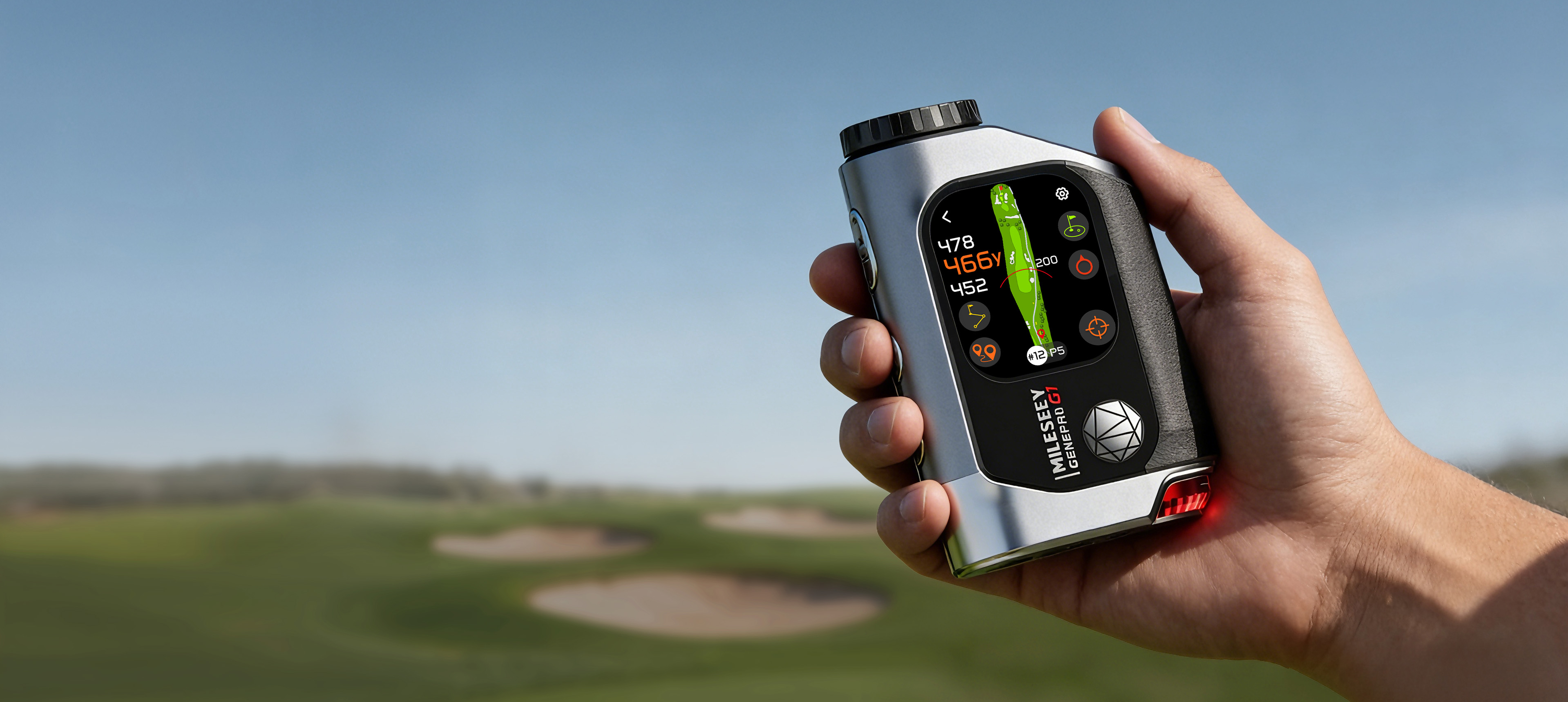
The MILESEEY GenePro G1 combines laser measurement, GPS mapping, and an AMOLED display. Golf Monthly called it one of the best laser/GPS combinations the reviewer had tested and praised the bright full-hole display, while noting lag and automatic-hole-change issues. It suits a tech-comfortable beginner who wants one device for target distance and hole context, but it demands more attention than a simple laser.
See the live golf rangefinder collection after choosing which profile matches your learning style.
A first-round learning plan
Use only three measurements
For the first few rounds, limit the device to:
- Carry distance over a hazard.
- Distance to a visible pin or safe green target.
- Lay-up distance on a par 5.
Do not use every mode immediately. Record one case where the number changed your decision and one where it did not. Add features only when a repeated problem justifies them.
When a beginner should wait
If the golfer does not yet know approximate club carries, the rangefinder number may create false precision. Start with a lesson, marked-range session, or launch-monitor baseline. If the player struggles to hold a small optic steady, test stabilization or larger displays before buying.
Bottom line
Choose a beginner rangefinder for clarity, confirmation, slope control, power, and support. A simple laser is often enough. Move to advanced laser or hybrid features only when they solve a real, repeated decision on the course.